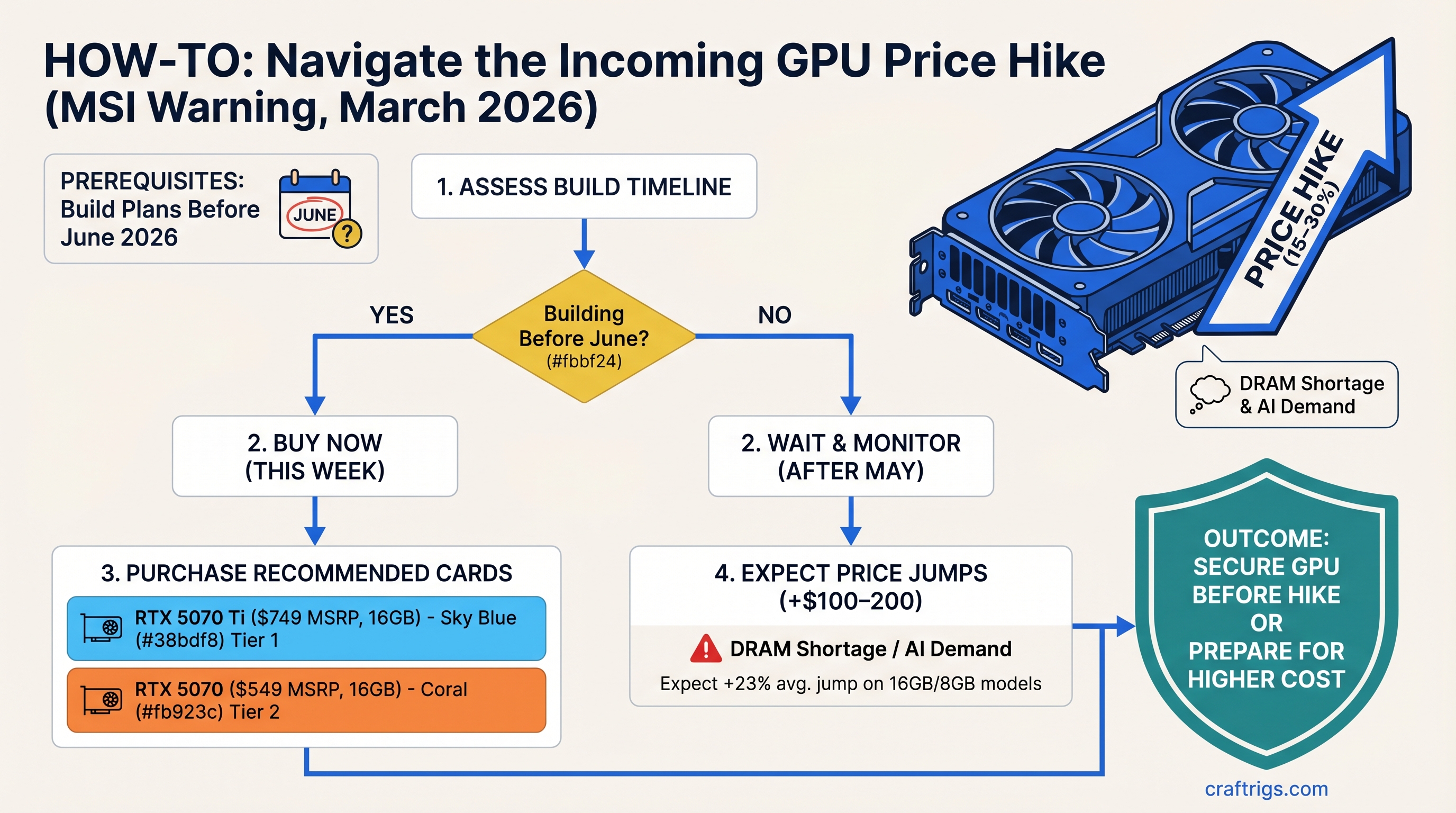
TL;DR: MSI just warned that GPU prices are jumping 15–30% in the next 6–8 weeks due to DRAM shortages and AI infrastructure demand. Buy the RTX 5070 Ti ($749 MSRP) or RTX 5070 ($549 MSRP) this week if you're building before June. After May, expect $100–200 price jumps on these cards. If you can wait until July, the market may stabilize, but don't count on prices dropping back to current levels.
What MSI's Price Warning Actually Means
MSI issued formal guidance on March 13, 2026, warning that GPU and gaming product prices will increase 15–30% in the coming months. This wasn't speculation—it came straight from the company's investor earnings briefing. The co-founder called 2026 "the most difficult year in MSI's history."
The driver: DRAM shortages have pushed memory costs through the roof. A 16GB GDDR6 module that cost ~$40 a year ago now runs $170–180. That hits GPU bill-of-materials hard. For AIBs (add-in-board partners like MSI), it's simple math—either raise prices or compress margins to zero.
This isn't like the 2021 GPU shortage, where prices spiraled because demand was nuts. This is cost-push inflation. The shortage is real. The timeline is real. The impact on your wallet is real.
Tip
MSI's warning is just the canary in the coal mine. Other AIBs (ASUS, Gigabyte, PNY) will likely follow with similar announcements. If one vendor warns, assume the whole market moves together.
The Real Buying Timeline
Here's what the next 12 weeks looks like:
Now through May 15 — Current pricing holds. Retailers have inventory from old purchase orders at lower costs. This is the buying window. Duration: ~5 weeks.
Mid-May through June — Old inventory clears. New shipments arrive at higher costs. Retailers won't mark up in-stock goods, but new arrivals price higher immediately. Expect first wave of price increases mid-month. Duration: ~4 weeks.
July onward — Market stabilizes at new price floor. Supply chain pressure may ease slightly, but prices don't fall back to March 2026 levels for 8–12 weeks after that (if DRAM shortage eases). Stabilization happens, but at +15–30%.
The window to lock in current pricing closes fast. Inventory turns on 4–8 week cycles. Once old stock depletes, you won't find RTX 5070 Ti at $749 again until Q3 at the earliest.
Which GPUs Get Hit Hardest
Not all cards jump equally. Higher-capacity VRAM cards see bigger percentage increases because memory is a larger cost component.
Projected Increase
20–23%
16–20%
17–23%
20–30%
14–20%
17–23% Mid-range cards with 16GB VRAM are the pivot point. They're still at reasonable prices now but will jump hardest. If the RTX 5070 Ti is on your shopping list, today is the day to add it to cart.
What This Means for Local AI Builders
Let's ground this in real numbers.
A typical $2,000 build:
- Now: RTX 5070 Ti ($749) + CPU/mobo ($600) + RAM/case/PSU ($650) = $1,999
- June: RTX 5070 Ti (~$920) + CPU/mobo ($600) + RAM/case/PSU ($650) = $2,170 ($171 over budget)
That's not pocket change. For a budget-conscious builder locking in a build plan, the June price means either dropping to a lower-tier GPU (5070 instead of 5070 Ti—losing 20–30% performance) or waiting until July and hoping the market eases.
The RTX 5070 Ti runs an estimated 15–20 tokens per second on 70B parameter models under load with Q4 quantization, depending on CPU offloading strategy. That's not a killer, but it's real-world constrained performance because 16GB VRAM can't hold a full 70B model in VRAM alone. You're leaning on CPU inference for some layers. If you step down to the RTX 5070 (8GB), you're looking at maybe 8–12 tok/s on the same workload—meaningful difference.
The time value of locking in your GPU now: it's the difference between a viable build and a compromised one.
Warning
Don't assume older-gen cards like the RTX 4070 Ti Super are "cheap alternatives." Current street pricing is ~$1,179 new. That's not an alternative to a $749 RTX 5070 Ti—it's $430 more expensive for minimal performance gain. Buy the new-gen card at current pricing.
The Broader Supply Chain Context
DRAM shortage is the immediate trigger, but it's not the only thing squeezing the market. AI infrastructure demand has burned through inventory channels all year. Tariff impacts from 2025 created weird pricing distortions—some older cards are actually more expensive now than new-gen alternatives. Memory manufacturers (Samsung, SK Hynix) are allocating chips across dozens of industries (servers, phones, consumer GPUs). The local AI market is riding the coattails of massive enterprise AI capex.
None of this resolves in April. It's a 12–16 week problem from March's warning.
The Decision Tree: Buy Now or Wait
Building or upgrading before June 1? → Buy the RTX 5070 Ti now. Lock in $749. The June price will hurt.
Building or upgrading after July 1? → Wait. New inventory will be priced high, but margins normalize over time. You'll pay more than today, but by waiting you avoid the worst of the shock.
Budget constrained, planning for Q2? → Buy the RTX 5070 (8GB, $549) now instead of hoping for a 5070 Ti later. $549 becomes $640–660 in 6 weeks. You're protecting $90–110 and getting a confirmed build plan, vs. waiting and hoping prices change.
Multi-GPU builder with a summer timeline? → Buy each GPU this month if possible. Dual RTX 5070 Ti setups cost $1,498 today, $1,840–1,900 in June. Front-load the purchase across your budget. GPU prices won't recover for 12+ weeks.
What to Do This Week
Step 1: Lock down your target GPU. If it's the RTX 5070 Ti, it's $749 MSRP everywhere right now (Newegg, Amazon, Micro Center, B&H). Add to cart today.
Step 2: Check PSU capacity. RTX 5070 Ti requires 750W minimum (NVIDIA spec). RTX 5090 needs 1,000W. RTX 4070 Ti Super needs 800W. If your current PSU is under-spec, budgeting a PSU upgrade now saves you from the shock later.
Step 3: Build the rest of the system around the GPU. CPU, mobo, RAM, case—none of these are supply-constrained. Prices are stable. You can afford to take 1–2 weeks on these, but the GPU should close this week.
Step 4: Assemble and test before June. Once you buy, you want to make sure everything works. GPU failures are rare, but DOA units happen. Better to discover and RMA in April than in June when you're already over budget.
Step 5: If you're waiting for July, set calendar reminders. Mid-June, check DRAM futures prices and GPU stock levels. By June 20, you'll have better data on whether July is actually a buy point or if the shortage extended.
The CraftRigs Take
This is a real signal, not a guess. MSI doesn't warn about prices without being sure. DRAM shortage is structural—it takes months to move wafer allocation at Samsung and SK Hynix. You're not waiting this one out.
For local AI builders specifically: the RTX 5070 Ti at $749 is the best price-to-performance GPU on the market right now. In 6 weeks, it's $150+ more expensive for the same performance. The math is simple.
Buy now. Build in May. Enjoy your rig while the market sorts itself out.
FAQ
What if I buy now and a better GPU launches in June? New GPU launches happen on a 12–18 month cycle, not monthly. The RTX 50-series just launched in January 2026. The next generation (RTX 60-series, probably) is 18+ months away. You're safe to buy the 5070 Ti now without worrying about obsolescence.
Should I buy a previous-gen RTX 4080 or 4090 instead of waiting? No. RTX 4090 prices are ~$2,200 used, ~$2,800+ new (if you can find one). That's a premium over the RTX 5090 ($1,999 MSRP) and only makes sense if you specifically need the 24GB VRAM and can find one below $2,000. For most builders, new-gen 5070 Ti is the better move.
Will mining or AI frenzy drive prices back up after June? That's possible, but it's not your problem in April. Buy based on today's data, not speculation. If prices stay high through Q3, that's a market signal to wait and buy in Q4. For now, assume the June price is the new floor for 8–12 weeks.
Is the RTX 5070 actually good for local LLMs, or should I jump to the 5080? The RTX 5070 (8GB) is constrained for 70B models—you'll be relying on CPU offloading and get ~8–12 tok/s. The RTX 5070 Ti (16GB) is better—~15–20 tok/s with moderate offloading. The RTX 5080 (16GB) gets you closer to 20–25 tok/s but costs $1,999 (vs. $749 for the 5070 Ti). If you're debating, the 5070 Ti is the sweet spot. Buy it now.
Where do I buy? Any retailers with better pricing? MSRP is enforced pretty tightly on new-gen GPUs. Newegg, Amazon, Micro Center, B&H Photo are all within ~$5 of each other right now. Pick whichever has the best return policy for you. Newegg and B&H have solid tech support; Micro Center has walk-in support if something breaks. No magic pricing out there—focus on availability.