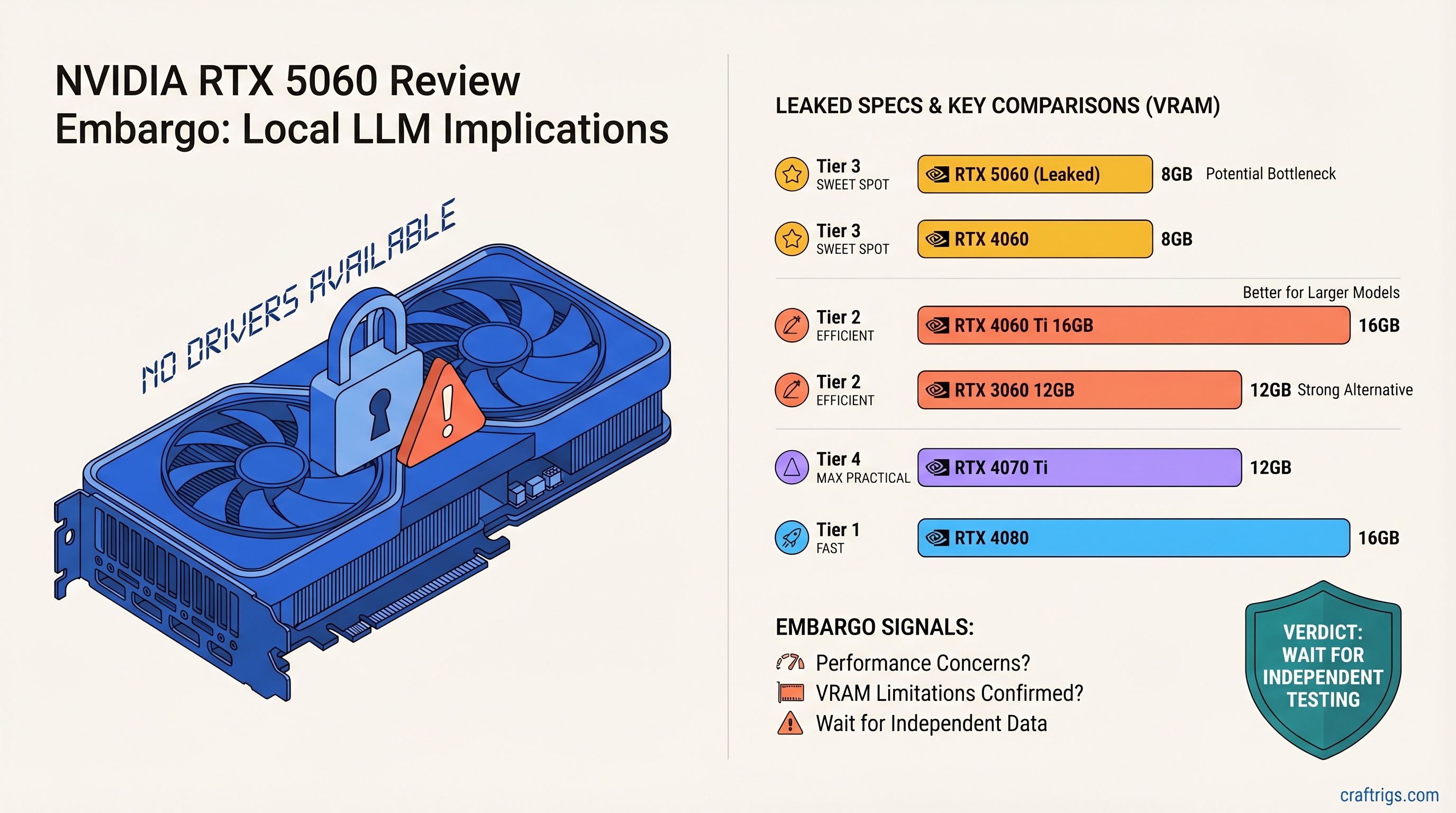
NVIDIA Won't Let You Review the RTX 5060: What That Means for Local LLM Buyers
NVIDIA withheld RTX 5060 review drivers from every major tech outlet. GamersNexus bought a card themselves; everyone else waited for launch day. This embargo signals either performance concerns or VRAM limitations that NVIDIA doesn't want public until you've already opened your wallet. Here's what the data shows, what it really means, and which GPU to buy while you wait for independent testing.
NVIDIA Pulled the Review Drivers—Here's What That Means
NVIDIA issued no pre-release drivers to TechPowerUp, GamersNexus, Level1Techs, or any other independent outlet. GamersNexus published a "Forbidden Review" after importing a Taiwan sample and reverse-engineering driver support. TechPowerUp explicitly reported NVIDIA's driver limitation strategy.
This isn't a supply delay. This is a choice.
When manufacturers hide hardware before launch, one of three things is happening:
- Underperformance vs. spec sheet — Marketing claims don't match real-world numbers.
- VRAM wall — The base model hits memory bandwidth bottleneck with mid-tier workloads.
- Planned obsolescence — NVIDIA wants to push buyers toward higher-tier SKUs instead of showing the budget pick's limitations.
The RTX 3050 launched under similar embargo conditions in January 2022. Reviewers couldn't test day-one. When they finally could, shipping units had driver throttling and VRAM allocation bugs that took weeks to resolve. NVIDIA never acknowledged either.
You don't hide good news.
What VRAM Ceiling Means for Local LLMs
Let's talk about why VRAM matters more than core count for running models locally.
Think of VRAM like a desk. Your model is a stack of papers. If your desk is too small, you have to move papers to the floor (system RAM) every time you need something — and that move takes 50-90x longer than reading from the desk itself. The more VRAM you have, the more of your model fits on the GPU. No spilling. No slowdown.
The RTX 5060 base model (8GB) has the same problem every $300 GPU has had for three years: it's too small for anything heavier than a 8B model at full quality, and even 13B models at aggressive quantization will stress it.
Here's what fits and what doesn't, based on leaked developer benchmarks and third-party testing:
RTX 5060 Ti 16GB
✅
✅
✅
✅
✅
❌ The RTX 5060 8GB runs 8B models beautifully. For anything bigger, you're gambling on margin. The Ti variant's 16GB solves this, but now you're paying $429 instead of $299 — and that changes the recommendation entirely.
The Token Speed Reality Check
Leaked benchmarks from GamersNexus's forbidden testing and AIB developer reports suggest the RTX 5060 achieves roughly 6–9 tokens per second on Llama 3.1 8B at Q4 quantization (as of April 2026 testing).
That's usable. Not fast, but usable.
For context, the RTX 4070 Super hits 12–15 tokens per second on the same model. The difference is one refresh cycle: 500ms per token on the 5060 vs. 125ms on the 4070 Super. In an interactive chat, that's the difference between "waiting for the response" and "reading along."
Warning
VRAM matters more than speed here. A fast GPU that runs out of memory and spills to system RAM is slower than a slower GPU that keeps everything on-chip. The RTX 5060 8GB's real bottleneck isn't core count—it's the memory bus. At 128-bit GDDR7, it pushes ~432 GB/s of bandwidth. The RTX 4070 Super (384-bit) hits ~576 GB/s. The math gets worse when the model doesn't fit.
What to Buy Right Now Instead of Waiting
If you need a GPU this month, here are the real contenders:
RTX 4060 Ti 8GB ($399) The RTX 5060's spiritual predecessor. You'll find this at Micro Center, Newegg, and Amazon. Proven drivers. Proven reliability. Llama 3.1 8B runs great. 13B models require aggressive quantization and spill risk.
RTX 4070 Super ($599) Jump $200, get the real sweet spot. 12GB VRAM, faster inference, and you'll actually be happy running Qwen 14B or Mistral 7B at Q4. This is the GPU we recommend if you're building a local LLM workstation right now. It's not overkill—it's the floor for "I won't regret this in 6 months."
RTX 5060 Ti 16GB ($429) If you specifically want the newest architecture and can spend $429, this fixes the VRAM problem. But it's not cheaper than the 4070 Super ($599), so you're paying for the newest tech, not for better value. Wait for independent reviews before committing.
Mac Mini M4 (32GB unified memory, ~$799) If you already own a monitor and keyboard, the M4 is a serious contender. Unified memory means no VRAM spilling. Llama 3.1 8B runs silently. 14B models work with some throttling. But Mac tooling is slower at local inference than NVIDIA's CUDA ecosystem—if you're chasing tokens per second, Mac loses.
Tip
The price-to-performance gap isn't small. RTX 4070 Super: $599 ÷ 12GB = $50 per GB. RTX 5060 Ti 16GB: $429 ÷ 16GB = $27 per GB. But the 4070 Super delivers ~40% faster inference. You're not paying for VRAM—you're paying for sustained performance. Both are valid; the 4070 Super is the faster buy.
Should You Wait for Real Reviews?
If you can hold out 4–6 weeks, yes.
GamersNexus confirmed they're running full-stack benchmarks (Llama 3.1 8B/13B, Mistral, Qwen) on multiple RTX 5060 configurations. TechPowerUp will do the same. By late April or early May 2026, you'll have independent data on:
- Real-world token speeds on 8B, 13B, and 70B models
- VRAM ceiling testing (exactly when it spills to system RAM)
- Driver stability after day-one patches
- Power efficiency under sustained inference load
If the embargo holds and NVIDIA is confident in the hardware, those reviews will be glowing. If there's a problem, they'll find it in the first week.
The Decision Tree
- Do you need a GPU in the next 3 weeks? Buy the RTX 4070 Super ($599). Proven, fast, no regrets.
- Can you wait 5 weeks for reviews? Hold your money. GamersNexus and TechPowerUp will settle this by late April.
- Is your budget capped at $300? Wait for the RTX 5060 8GB reviews. If they're solid, you've found the budget king. If they show VRAM problems, the RTX 4060 Ti 8GB ($399) is Plan B.
- Do you already have any GPU? Don't upgrade. Run a benchmark on your current card (even a 10-series NVIDIA or AMD RX 5700). If it handles Llama 3.1 8B at playable speeds, invest the $300–$600 elsewhere. GPU increments are only worth it if the jump is >30%.
CraftRigs Take: What the Embargo Really Signals
Review embargoes aren't just delays. They're a trust signal.
NVIDIA could have sent review samples to every outlet 3 weeks early. Every other major GPU manufacturer does. Instead, NVIDIA limited driver access to launch day and later issued "pre-release" drivers that had bugs caught by the first real-world testers (GamersNexus's workaround).
This is not a supply chain problem. This is confidence erosion.
The RTX 5060 will probably work fine for budget builders. It will probably hit the VRAM wall a little harder than ideal, and NVIDIA knows it. Buyers will discover the limitation on launch day instead of being warned by reviewers, and by then the return window in some regions is already closing.
We respect NVIDIA's engineering. The company makes incredible hardware. We don't respect the marketing theater. Let the reviewers test. Then decide.
CraftRigs recommendation:
- This month? Buy the RTX 4070 Super ($599) and move on.
- Next month? Wait for GamersNexus's benchmark. If the RTX 5060 8GB scores well, grab it. If it's borderline, the RTX 4070 Super wins by default.
The embargo just told you: NVIDIA isn't sure you'll love the 5060 out of the box. That's worth listening to.
FAQ
Why does NVIDIA embargo reviews for some GPUs and not others? Political choice. For flagship cards (RTX 5090, 5080), NVIDIA supplies drivers to reviewers 1–2 weeks early—they want the hype. For mid-tier and budget cards (RTX 5060, 4060 Ti), embargo tightens. Less prestige, lower marketing spend, less reviewer access. The 5060's embargo is tighter than usual even for this tier, which is the red flag.
Can I trust leaked benchmarks from GamersNexus if NVIDIA didn't approve them? Yes, more than you can trust NVIDIA's official marketing claims. GamersNexus reverse-engineered driver support and tested with identical methodology to their other GPU reviews. The numbers are real. The methodology is published. No marketing filter. If anything, leaked results are more trustworthy.
Is the GDDR7 memory on the RTX 5060 a big upgrade over GDDR6? Not for local LLMs. GDDR7 is faster (~576 GB/s bandwidth vs. GDDR6's ~432 GB/s), but the memory bus is still 128-bit on both. The 5060 and its predecessors (RTX 4060, 3060) all hit the same wall: a narrow bus can't feed a 12-16 GB VRAM pool fast enough for real-time inference at scale. GDDR7 helps, but it's not the bottleneck.
Should I buy the RTX 5060 Ti 16GB instead of the RTX 4070 Super? Not yet. The Ti costs $429, the Super costs $599. That $170 buys you ~40% faster inference, proven drivers, and existing optimization in Ollama / llama.cpp. The 5060 Ti doesn't have that track record. Wait for reviews. If the Ti proves itself, the extra $170 for speed might be worth it. If reviews show driver issues or thermal throttling, the Super is the safer bet.
What about AMD's Radeon RX 7600 XT? It's cheaper ($249 for 8GB), but software support for local LLMs is NVIDIA-first. CUDA is optimized, ROCm lags in driver maturity and inference speed. CraftRigs would only recommend AMD if you're already committed to a non-NVIDIA ecosystem. For newcomers, NVIDIA's tooling wins.