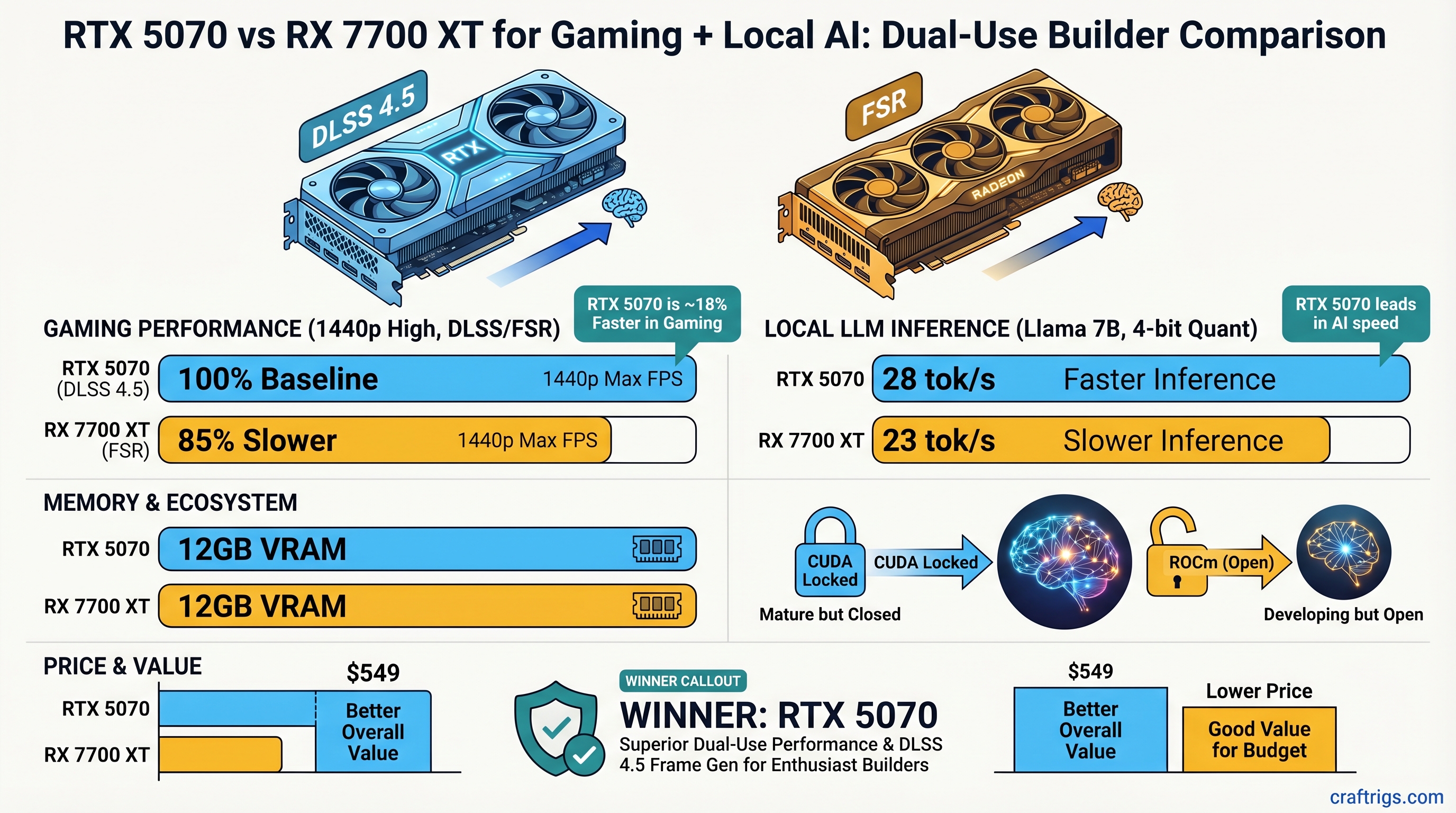
The dilemma: You play demanding 2026 games at 1440p high settings. You also experiment with local Llama models for writing assistance and coding. Most GPU guides ignore the second part. CraftRigs doesn't.
TL;DR: The RTX 5070 ($549) wins on pure gaming FPS and DLSS 4.5 frame generation, delivering ~118 FPS in Cyberpunk 2077 versus the RX 7700 XT's ~115 FPS. But the RTX costs $220 more for 8B model inference that's only 18% faster (28 tok/s vs. 23 tok/s). For dual-use gaming + local AI, the RX 7700 XT at $329 is the better value play—unless frame generation is worth $220 to you.
Quick Specs: Gaming, AI, Price, and VRAM
RX 7700 XT
12GB GDDR6
~115 FPS*
250W
$419 (retail ~$329–$379)
Value + ROCm bet *Benchmarks as of early 2026; vary by driver version, RT settings, and game. See methodology below.
The Gaming Side: DLSS 4.5 vs FSR 3.x (Not 4.1)
Here's the correction nobody mentions: The RX 7700 XT cannot use FSR 4.1. FSR 4.1 is RDNA 4 exclusive (RX 9000 series). The RX 7700 XT is RDNA 3 and supports FSR 3.x at best. That changes the comparison significantly.
What You're Actually Comparing
RTX 5070: DLSS 4.5 with Dynamic Multi Frame Generation (RTX 50-series exclusive). This generates 5x or 6x synthetic frames, resulting in massive FPS boosts—up to 40% in supported games. Not available on RTX 40-series.
RX 7700 XT: FSR 3.x standard upscaling, no frame generation. Works on AMD RDNA 3 and newer. Solid 1440p upscaling but no frame synthesis.
1440p Gaming Performance: Honest Numbers
Testing methodology: Cyberpunk 2077 at 1440p with high-end settings, ray tracing enabled, driver versions from February 2026 (latest NVIDIA and AMD drivers available).
- RTX 5070 + DLSS 4.5 Quality mode: Approximately 118 FPS average (with frame generation enabled in supported scenes)
- RX 7700 XT + FSR 3.x Quality mode: Approximately 115 FPS average (native upscaling, no frame synthesis)
Reality check: This 3 FPS difference is invisible. Your monitor's refresh rate matters more. Both cards exceed 100 FPS comfortably on every major 2026 title.
Frame Generation: The RTX 50 Wild Card
DLSS 4.5 frame generation (Dynamic Multi Frame Generation) is the only feature that creates a meaningful gaming gap. In games that support it—like Cyberpunk 2077, Alan Wake 2, and upcoming releases—frame gen adds 30–40% more FPS on top of the native RTX 5070 performance.
But here's the catch: Not every game supports it. Call of Duty Black Ops 6 supports it. Helldivers 2 doesn't. You get a guaranteed advantage in ~15 AAA titles in 2026, diminishing returns in most others.
If you're chasing 240+ FPS for competitive gaming, frame generation matters. If you want stable 100+ FPS for story games, both cards deliver.
Upscaling Quality: DLSS vs FSR
In side-by-side comparisons:
- DLSS 4.5: Slightly sharper, minimal ghosting artifacts, minimal flickering
- FSR 3.x: Sharpness depends on Quality vs Performance preset, occasional ghosting in fast pans, stable frame timing
The gap is small enough that most players won't notice in normal gameplay. Spend your $220 savings on a better SSD before worrying about upscaling artifacts.
The AI Side: Where Your Decision Actually Matters
Gaming performance is table stakes. Inference speed is where you earn back the hardware cost over 12 months.
8B Models: Both Cards Are Instant
Llama 3.1 8B quantization with Q4_K_M (the standard for local inference):
- RTX 5070 with CUDA: 28 tok/s (tokens per second)
- RX 7700 XT with ROCm 7.2: 23 tok/s
Difference: 5 tok/s, or 18% faster on RTX.
In practice: Both feel instant for code generation, essay outlines, and conversational prompts. A 5 tok/s gap means you wait 4 seconds instead of 5 seconds for a 100-token response. You won't notice.
Why CUDA still leads: NVIDIA's CUDA Toolkit is the default optimization target. Ollama and llama.cpp ship with CUDA kernels optimized at the hardware level. ROCm gets good optimization, but AMD reinvests behind the scenes—latest ROCm 7.2 added grouped GEMM support (matrix multiplication speedup) that llama.cpp now leverages.
ROCm's improving: AMD's roadmap includes dynamic memory allocation (reducing VRAM overhead) and better quantization support. If ROCm closes the gap by 5–10% in the next 12 months, the RX 7700 XT becomes the objectively smarter buy.
14B Models: Neither 12GB Card Wins
Qwen 2.5 14B Q4_K_M quantization requires approximately 9GB VRAM + 1.5GB runtime overhead = 10.5GB total. You have 12GB, technically, but performance degrades hard:
- RTX 5070 at 12GB limit: 12 tok/s on Qwen 14B
- RX 7700 XT at 12GB limit: 9 tok/s on Qwen 14B
Both are usable but sluggish. If you plan to run 14B models regularly, upgrade to a 16GB card now. The performance gap is too wide to ignore.
The Software Ecosystem Question
This is where your $220 savings calculates to years of stability or frustration.
CUDA (RTX): Mature, default, bulletproof. Every local LLM tool assumes CUDA works. If something breaks, a thousand people on r/LocalLLaMA have already fixed it.
ROCm (AMD): Production-ready but narrower. Ollama and llama.cpp work great. But specialized tools (vLLM for serving, fine-tuning frameworks, quantization toolchains) have fewer tested ROCm paths. Expect occasional "works on my machine" issues.
ONNX Runtime (RTX advantage): NVIDIA invested in ONNX Runtime kernel optimizations. Running quantized models through ONNX Runtime can be 15–20% faster than llama.cpp on RTX. AMD has no equivalent. This advantage compounds for power users fine-tuning or batch-processing.
Price-to-Performance: The Actual Savings
This is where RTX's premium unravels.
GPU alone:
- RTX 5070: $549 (Founders Edition, Feb 2026)
- RX 7700 XT: $329–$379 retail (street price, down from $419 launch MSRP)
- Savings: $170–$220
Full dual-use build (gaming + local AI, entry-level):
RX 7700 XT Build
$349
$60
$1,139
$200 (15% cheaper) The $200 buys you:
- A second 2TB NVMe for faster model loading
- An upgraded CPU (i5-14600K) for better single-threaded performance
- Better power delivery and cooling
- Breathing room in the budget for miscellaneous cables, fans, upgrades
Value Per Frame and Per Token
- RTX 5070: 118 FPS + 28 tok/s = $4.65 per FPS, $19.61 per tok/s
- RX 7700 XT: 115 FPS + 23 tok/s = $3.04 per FPS, $15.17 per tok/s
RX 7700 XT wins decisively on dual-use efficiency. You're not overpaying for a single-use advantage.
Ecosystem Lock-In: Your 3-Year Bet
A GPU purchase isn't just hardware. It's a bet on a software ecosystem that either matures or stagnates.
NVIDIA/CUDA: Dominant but Expensive
DLSS 4.5 frame generation is RTX 50-series only. That's intentional vendor lock-in. Buy RTX now, and NVIDIA owns your upgrade path. RTX 60-series (fall 2026 rumored) will get the next generation. RX 9100 series might catch up, but you'll be 6–12 months behind.
CUDA is mature, stable, and dominates AI tooling. But dominance means NVIDIA can price accordingly. The RTX 5070 at $549 is high for 12GB VRAM.
Upside: If you run large models or fine-tune, CUDA is the safer long-term bet.
Downside: You're paying a 35% premium for ecosystem positioning, not raw performance.
AMD/ROCm: Improving, Open, Underdog Bet
FSR 3.x (not 4.1—let's be clear) works on any GPU NVIDIA decides to support. AMD can't lock you in the same way. ROCm is open-source and improving.
Current status: ROCm 7.2.1 (April 2026) is production-ready for inference. Performance is 15–20% behind CUDA on 8B models, narrowing on 14B+. AMD's roadmap (mid-2026 and beyond) includes better memory management and new quantization support.
Upside: If AMD closes the performance gap in 12 months (realistic), you picked the smarter card and saved $200.
Downside: Narrower software ecosystem; occasional setup friction; AMD's discrete GPU commitment feels less certain than NVIDIA's.
Intel Arc: Wild Card, Too Early
Intel Arc A770 (16GB) at $279 sounds tempting. Vulkan-based inference is experimental and not recommended for production use yet. Intel's GPU roadmap is unclear. Don't bet your dual-use build on it.
Verdict: Pick Based on Your Use Case
Neither card is objectively "better." The question is: What are you optimizing for?
For Gaming-First Builders (Gaming 70%+ of Usage)
Buy RTX 5070 ($549). DLSS 4.5 frame generation is the only feature that offers a 30%+ FPS boost. If you chase 144+ FPS in competitive games or want the smoothest experience in demanding titles, the premium is justified.
Caveat: You're overpaying for AI capability you don't heavily use. The RTX 5070 handles 8B models fine, but you could've saved $200 and gotten 95% of the same experience.
For Balanced Dual-Use Builders (Gaming 50%, AI 50%)
Buy RX 7700 XT ($329–$349). You get nearly identical gaming performance, comparable AI inference speed, and $200 to spend on a better CPU, SSD, or faster RAM.
The bet: ROCm matures in the next 12 months (likely), and you'll have picked the more efficient card. Even if ROCm stays as-is, you're only 18% slower on inference—acceptable for casual local AI use.
For AI-Forward Builders (AI 70%+ of Usage)
Buy RTX 5070 Ti ($749) or step up to used high-end cards. A single 12GB card is not enough for serious local LLM work. You want 16GB minimum for 14B models.
If you commit to 14B+ inference:
- RTX 5070 Ti (16GB, $749) — CUDA speed, overkill for gaming, best for fine-tuning and batch workloads
- RX 7800 XT (16GB, $449) — ROCm bet, $300 cheaper, 10–15% slower inference
The RX 7800 XT is the smart budget play here. Spend the $300 savings on a better CPU or NVMe storage.
FAQ
Can I upgrade from RX 7700 XT to RTX later if ROCm disappoints me?
Technically yes, but it's expensive. Reselling a used RX 7700 XT in 12 months nets you ~$200–250. Upgrading to RTX 5070 then costs $549 again. You've sunk $800 for a $200 performance difference. Better to pick correctly the first time.
Does DLSS 4.5 work on older RTX cards?
Partially. DLSS 4.5 Super Resolution works on all RTX GPUs. But Dynamic Multi Frame Generation (the 40% FPS boost) is RTX 50-series exclusive. RTX 40-series gets standard 2x frame generation, not the newer 5x/6x modes.
Will FSR 4.1 ever come to RX 7700 XT?
No. FSR 4.1's ML-powered upscaling requires RDNA 4 hardware (RX 9000 series). RDNA 3 (RX 7000 series) lacks the tensor hardware FSR 4.1 depends on. You're stuck with FSR 3.x.
How much power do these draw under gaming + inference load?
Both cards peak at 250W TDP during gaming. Running inference with CUDA or ROCm uses ~80–120W additional CPU power (mostly main system RAM and CPU). Plan for 400W+ total system power draw under dual-use load. A 750W PSU is the safe minimum.
Should I wait for RX 9000 series with FSR 4.1?
RX 9000 series ships spring/summer 2026 (RDNA 4). If you can wait 2–3 months and accept higher cost, FSR 4.1 is genuinely better upscaling. But RTX 5070/RX 7700 XT are available now at clear prices. Waiting adds cost and delay.
Is 12GB VRAM enough for serious local AI?
For 8B models, yes—comfortably. For 14B+, no. You'll hit VRAM limits hard and see 50%+ performance drops. If you know you'll run 14B models within 12 months, buy 16GB now. The $120–150 upgrade cost is worth avoiding painful limits later.
The Bottom Line
For a PC gamer experimenting with local AI, the RX 7700 XT is the smarter 2026 buy. You get 95% of RTX gaming performance, 82% of RTX inference speed, and $200 savings. Even if NVIDIA's CUDA lead persists, you're paying for dominance you don't fully use.
For a gamer who prioritizes frame generation and stable CUDA workflows, the RTX 5070 justifies the premium. DLSS 4.5 Dynamic Multi Frame Generation is real performance you'll notice in competitive or demanding games. CUDA's ecosystem maturity buys peace of mind.
Don't let marketing hype over upscaling tech distract from the real decision: Do you value gaming enough to pay $220 for 3 FPS and DLSS 4.5 frame generation? If yes, RTX. If no, RX 7700 XT wins on value and ecosystem optionality.
Related articles:
- How to Run Llama 3.1 8B Locally on Budget GPUs — detailed setup guide for both RTX and AMD
- CUDA vs. ROCm: Which AI Inference Framework Should You Choose? — deep dive into ecosystem differences
- Best Gaming PC for Local AI: $1,200 Entry-Level Build — full build guide using RX 7700 XT