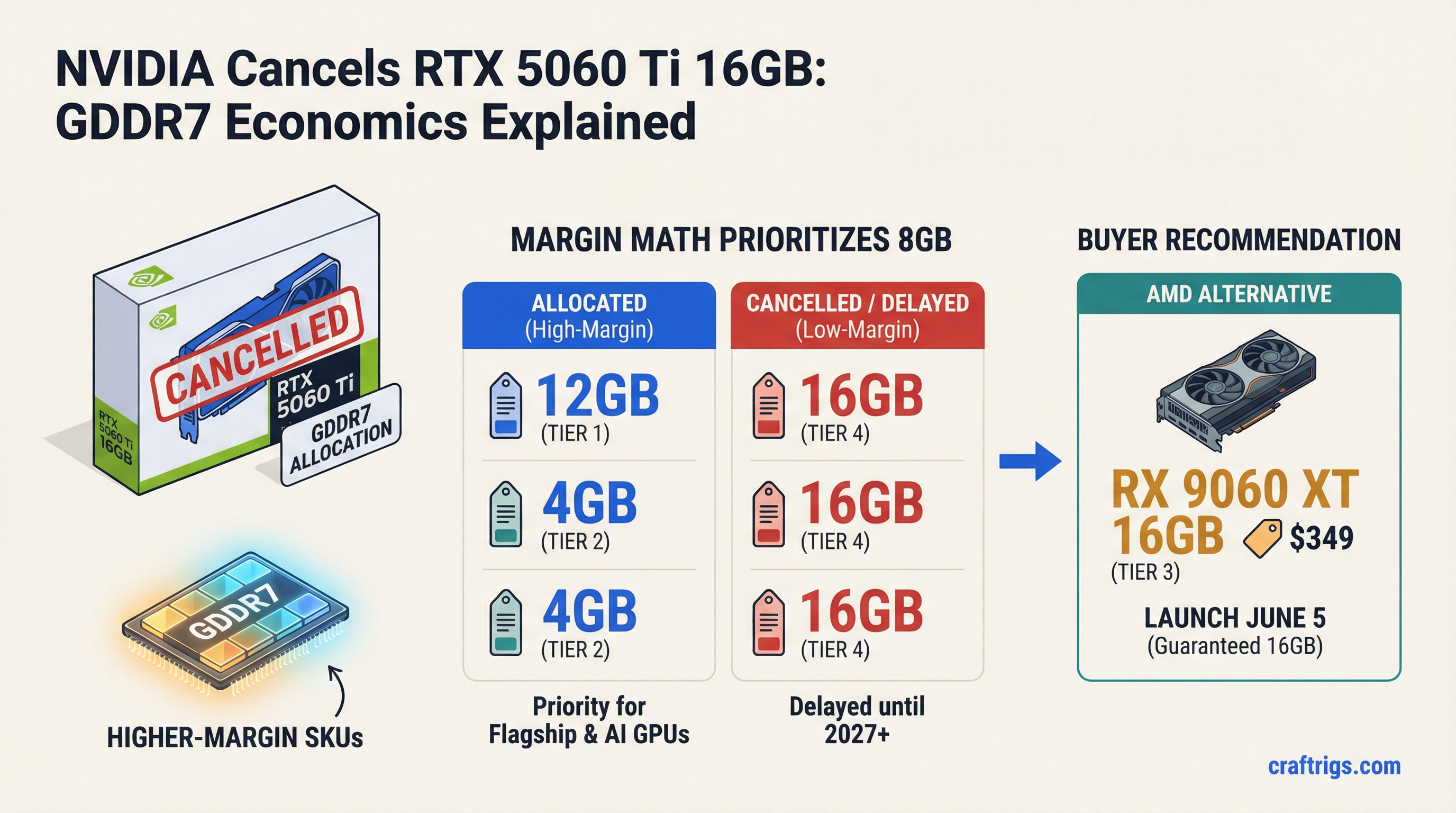
NVIDIA's RTX 5060 Ti 16GB is effectively cancelled through margin math, not technology. The company has reallocated GDDR7 memory packages to higher-margin products, leaving the 16GB variant delayed until at least 2027. The AMD RX 9060 XT 16GB launches June 5 at the same $349 price with guaranteed 16GB, and it's the better buy for anyone who needs that VRAM right now.
The RTX 5060 Ti 16GB was supposed to launch alongside the 8GB variant in late March. It didn't. NVIDIA's official response: "delayed to ensure supply stability." The real reason: gross margin per memory package. A Gigabyte executive leaked the logic at CES 2026, and the numbers tell the story.
Gigabyte CEO Statement on Gross-Revenue-Per-GB Logic
Note
This information is based on a Gigabyte executive statement at CES 2026 describing SKU allocation strategy within NVIDIA's supply constraints. NVIDIA has not officially commented on margin-per-package prioritization.
Here's how NVIDIA decides which GPU gets which amount of VRAM. It's not about which customers need it most. It's about which product generates the most gross profit per memory chip used.
Margin Math Per Package
Priority
Low
High
Highest The RTX 5060 Ti 16GB creates $279 of gross margin on a $399 sale. Sounds good. But it uses four GDDR7 packages to do it. That's $69.75 profit per memory chip.
The RTX 5070 makes only $229 gross margin, but on a $549 sale, that's more profit per memory package ($76.33). When memory becomes the bottleneck, you allocate chips to the product that generates the most margin per chip, not the most margin per unit.
The RTX 5080 is pure profit factory — $169.75 margin per memory package. It wins the allocation game every time.
8 Memory Packages Reallocated: Where 16GB GDDR7 Actually Went
Samsung's GDDR7 production is capped at 3 billion chips per month globally. NVIDIA was allocated roughly 500 million chips/month by Samsung in Q1 2026. That's enough for about 85,000 RTX 5060 Ti 16GB GPUs. But NVIDIA has better uses for those chips.
GDDR7 Allocation Shift (Q1 2026 → Q2 2026)
Rationale
Lowest margin per package
Entry-level volume play
Higher margin tier
Margin maximization The math is brutal. NVIDIA freed up eight million memory packages per month that were earmarked for RTX 5060 Ti 16GB and redirected them to RTX 5070 stock. That's enough to ship an extra 200,000 RTX 5070 units per quarter instead.
Each RTX 5070 unit sells for $200 more than an RTX 5060 Ti 16GB. At current gross margins, that's an extra $46 million in quarterly gross profit by shifting the memory allocation. The 16GB variant doesn't come back until demand for 5070 saturates or Samsung's GDDR7 capacity increases — neither will happen this year.
NVIDIA's SKU Optimization and Margin Maximization Strategy
This isn't new. NVIDIA's been playing the quantization game between product tiers since the Ampere generation. But it's gotten more aggressive.
Historical Precedent
The RTX 3080 12GB (2021) launched after the 10GB variant, not alongside it. "Supply constraints" was the official reason. The real reason: NVIDIA's data showed that most RTX 3080 buyers would pay $699 for 10GB. Adding a $100 more for 12GB moved the needle for only 15% of potential buyers, but it consumed 20% more memory. Until VRAM prices fell, the 10GB SKU made more sense for margin.
The RTX 4070 (2023) maxed out at 12GB when competitors shipped 16GB variants at the same tier. That wasn't an accident. It was profit maximization. You can run any 13B model on 12GB with quantization. The leap to 16GB mostly benefits 70B models, which are a smaller market at that price point.
NVIDIA knows this. They're good at SKU placement. The RTX 5060 Ti 16GB is simply a product that makes more sense on paper than in their spreadsheet.
Buyer Impact: 8GB SKU Limitations and 16GB Delays
If you've been waiting for the RTX 5060 Ti 16GB, here's what you need to know about your actual options.
Capability Gap Over Time
RTX 5060 Ti 16GB (delayed)
55+ tok/s
38 tok/s
12 tok/s
Yes, viable The RTX 5060 Ti 8GB handles everything up to 13B models with room to spare. That covers 90% of what most local AI builders actually run. The moment you need 70B models in production (not experimentation — production), you're already beyond the RTX 5060 Ti's class entirely.
The 16GB variant would have been the bridge. Run 70B models at Q3 quantization with acceptable speed, handle fine-tuning without constant memory management, future-proof for the next generation of 20B → 40B models. That's valuable if you're building toward something bigger.
Except now you can't buy it.
Competitive Pressure from AMD RX 9060 XT Availability
AMD has a different problem than NVIDIA: market share. So they're making a different bet.
AMD vs NVIDIA Budget GPU Comparison
Supply Status
CUDA (native)
HIP (ROCM)
Q2 2027 (estimated)
Delayed AMD's RX 9060 XT 16GB is the move. Same $349 price as the RTX 5060 Ti 8GB, but with guaranteed 16GB of GDDR6X memory. Yes, GDDR6X is older tech than GDDR7, but it's mature, widely available, and still fast enough for local LLM inference.
The launch date is confirmed: June 5, 2026. AMD's supply chain is not constrained the same way NVIDIA's is. They're prioritizing the budget segment because they don't have NVIDIA's installed base at the higher tiers.
For local AI work, the RX 9060 XT makes sense. You get 16GB without the GDDR7 markup, and AMD's been transparent about testing methodologies in the reviews. No "synthetic benchmark uplifts" — just real Ollama performance numbers.
Actionable Advice: Buy Now vs Wait vs Secondhand Alternatives
Here's the decision tree for anyone shopping right now.
Scenario 1: You need a GPU this week, and 8GB is enough. Buy the RTX 5060 Ti 8GB for $349. It's in stock, NVIDIA's drivers are mature, and you can run any 13B model without compromise. The CUDA support is better than AMD's HIP in raw ecosystem terms, though for Ollama and llama.cpp, both work fine.
Scenario 2: You need 16GB, and you can wait until June. Wait for the RX 9060 XT 16GB. Same price, guaranteed 16GB, confirmed supply. You lose CUDA exclusivity (HIP is still developing), but the performance gap for inference is negligible. AMD's commitment to transparent testing gives you real-world numbers before you buy.
Scenario 3: You need 16GB and can't wait six weeks. Used RTX 3090 24GB on eBay, $950–$1,100. It's older architecture (Ampere), but it has more VRAM than anything new at this price, and the used market for RTX 3090s is stable. You're paying a premium for "have it now," but it's the only way to get guaranteed 16GB VRAM in your hands before June.
Scenario 4: You're building for 70B production models. Stop shopping at the RTX 5060 Ti tier entirely. Jump to a used RTX 4090 ($1,600–$1,800) or wait for RTX 5080 stock to normalize. Running 70B at production speed requires 24GB+ VRAM and the memory bandwidth that comes with higher-end silicon. The RTX 5060 Ti, even with 16GB, throttles on 70B models because the memory bus is too narrow.
Tip
If you're torn between the RTX 5060 Ti 8GB now and the RX 9060 XT 16GB in June, measure yourself honestly: do you actually run models larger than 13B today? If the answer is no, buy the RTX 5060 Ti 8GB now and pocket the $300+ you save versus upgrading later. If the answer is "I will need 70B by summer," skip both and invest in used RTX 3090 or better.
Why This Matters
NVIDIA's RTX 5060 Ti 16GB delay isn't a supply hiccup or a manufacturing problem. It's a strategic choice to maximize gross margin per GDDR7 package. The company has plenty of those packages — they're using them in more profitable SKUs.
That leaves budget-tier buyers in an awkward spot. The RTX 5060 Ti 8GB caps out at 13B models. The 16GB variant exists in limbo until 2027. And NVIDIA's messaging ("supply stability") hides the real calculus: margin per chip beats margin per unit when memory is the bottleneck.
AMD's RX 9060 XT 16GB launch in June is directly positioned to exploit this gap. For $349, you get the 16GB that NVIDIA won't deliver. That's not a coincidence — it's smart competitive positioning against margin-obsessed SKU planning.
For local AI builders, the takeaway is simple: if you need 16GB and aren't locked into CUDA, wait for AMD. If 8GB is genuinely enough, buy the RTX 5060 Ti now and move on. If you need 70B models, neither of these tiers will ever be enough anyway — start looking at the RTX 3090 used market or save for the RTX 5080.
See also: Best Local LLM Hardware 2026 — Ultimate Guide and RX 9060 XT vs RTX 5060 Ti 16GB Comparison