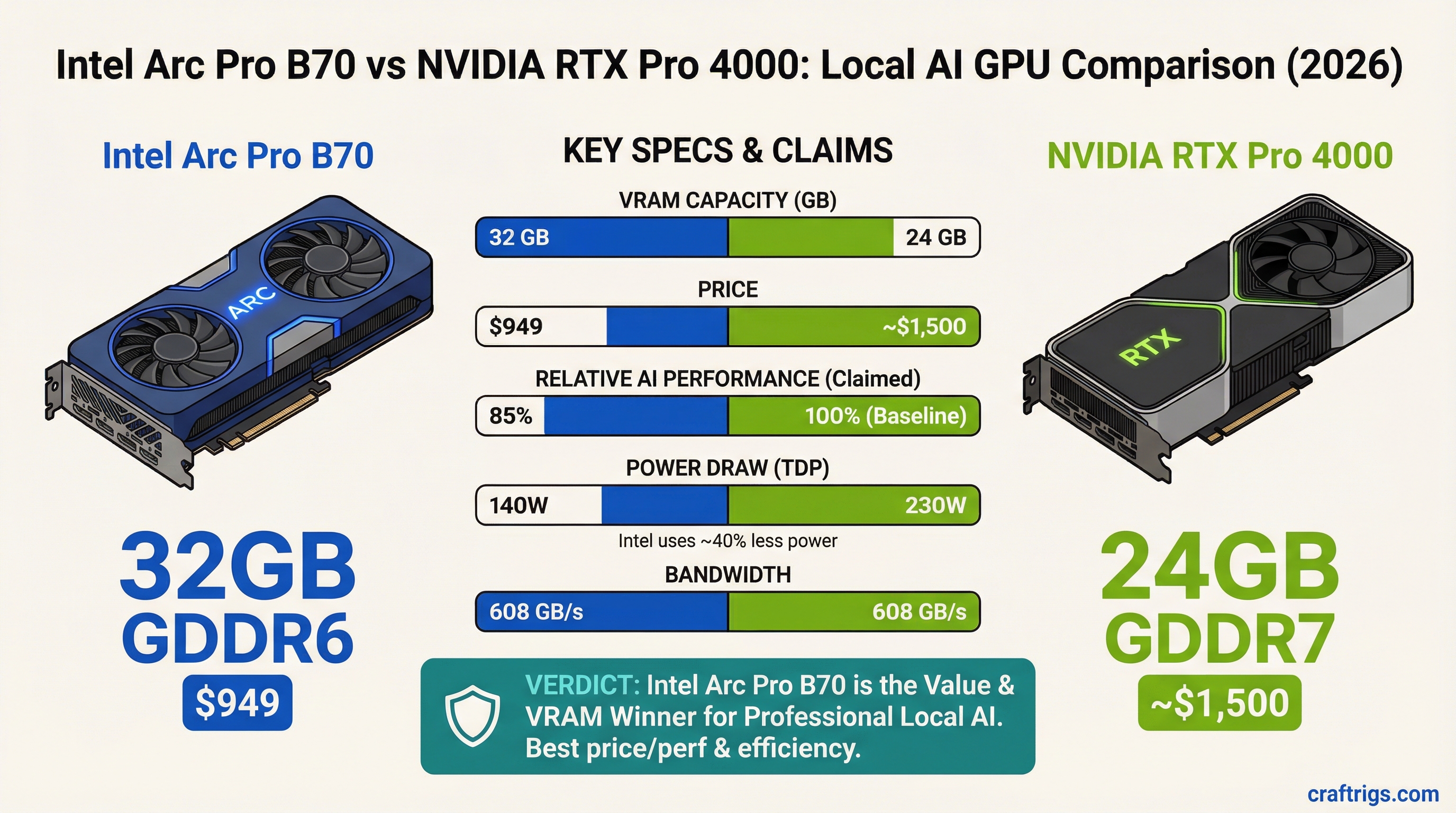
The most interesting GPU story of March 2026 isn't about NVIDIA. Intel just launched a 32GB workstation card for $949, targeting the same segment where NVIDIA has charged $1,500+ for years with minimal competition. The Intel Arc Pro B70 is real pressure on the RTX Pro 4000 Blackwell — and the specs make a compelling case for exactly the kind of professional local AI builder who's been waiting for an alternative.
But "compelling on paper" and "better for your specific workflow" aren't the same thing. Intel's VRAM and price advantages are genuine. So is NVIDIA's power efficiency edge and ecosystem depth. Here's what actually matters for each decision type.
TL;DR: The Arc Pro B70 wins on value — $949 for 32GB GDDR6 versus ~$1,500 for 24GB GDDR7 in the RTX Pro 4000 Blackwell. Intel's own benchmarks show 85% higher multi-user throughput and a 93K-token context window versus the Pro 4000's 42K on Llama 3.1 8B. But the RTX Pro 4000's 140W TDP is roughly 40% lower than the B70's 230W, and if you need Autodesk-certified drivers, neither card has fully confirmed status for the Blackwell generation. For inference-heavy professional workloads on a budget, the B70 is the rational choice. For power-constrained deployments, hybrid CAD+AI workflows, or risk-averse enterprise procurement, the Pro 4000 holds its ground.
Quick Spec Comparison
NVIDIA RTX Pro 4000 Blackwell
24 GB GDDR7
~$1,481–$1,546
~15.8 MB/$
42,000 tokens
2025 A few corrections to widespread early coverage. First: the B70's bandwidth is 608 GB/s — not the 288 GB/s that appeared in some launch-week summaries. Second: the RTX Pro 4000 uses GDDR7, not GDDR6, which is why it achieves 672 GB/s from a 192-bit bus rather than the 256-bit bus Intel uses. The actual bandwidth gap between these two cards is about 10%, not 33%. And third: the RTX Pro 4000 Blackwell is currently available at major resellers for $1,481–$1,546. Some outlets are reporting $1,800, which appears to be an earlier MSRP figure.
Why Bandwidth Is Closer Than You'd Think
Memory bandwidth sets the ceiling on how fast a GPU can stream model weights through its compute units — which is what determines tok/s on large language models. At 608 GB/s versus 672 GB/s, the B70 is about 10% behind. That's real but not decisive.
The more important number for most professional inference workloads is the context window. The B70's 32 GB VRAM lets it hold a 93,000-token context for Llama 3.1 8B at full BF16 precision — versus the RTX Pro 4000's 42,000 tokens with 24 GB. For legal document processing, long-context RAG pipelines, or multi-turn conversation agents, that gap is the actual bottleneck.
Note
The bandwidth figures above are manufacturer specs, not workload-specific measurements. Real inference throughput depends on model architecture, quantization level, batch size, and inference framework. Third-party benchmarks for the B70 are not yet published as of March 29, 2026.
Performance: What Intel Claims — and What That Means
Independent reviews take time. The B70 launched four days ago. The performance numbers below are Intel's own published benchmarks from March 2026 launch materials. They're disclosed as vendor-provided because the source matters.
According to Intel's launch benchmarks:
- Multi-user throughput, Ministral Instruct 2410 8B at BF16 on Linux: B70 achieves 85% higher token throughput than RTX Pro 4000 when handling concurrent requests
- Time to first token (TTFT), multiple simultaneous users: B70 is 6.2x faster
- Context window, Llama 3.1 8B BF16: 93,000 tokens (B70) versus 42,000 tokens (RTX Pro 4000)
The context window comparison is the number I'd trust most from this set, because it's directly calculable from VRAM capacity — it doesn't require Intel's testing methodology to be valid. With 8 GB more memory running the same model at the same precision, the B70 will always fit a larger context. That's math, not marketing.
The 85% multi-user throughput claim is where you need to be skeptical until independent benchmarks arrive. This kind of advantage is structurally plausible — more VRAM means more KV cache can stay in memory across concurrent sessions, reducing latency spikes under parallel request load. But "structurally plausible" isn't the same as verified. Take it as directionally meaningful, not as a precise number to quote.
Warning
No independent third-party benchmarks for the Arc Pro B70 existed as of article publication on March 29, 2026. All throughput claims above are from Intel's own launch materials. We'll update this article with independent benchmark results as they're published — check the publication date below the title.
Power Efficiency: RTX Pro 4000's Real Advantage
This is where NVIDIA has a clear, unambiguous edge. The RTX Pro 4000 Blackwell has a 140–145W TDP. The Arc Pro B70 runs at 230W reference, with partner board configurations ranging from 160W to 290W depending on the AIB design.
Running both cards 8 hours per day at $0.14/kWh, the RTX Pro 4000 costs roughly $58 per year in electricity. The B70 at 230W costs around $94 per year — about $36 more annually. That $72 difference over two years is negligible against the $532–$597 price gap in the B70's favor.
But power consumption matters more than the electricity math in two specific scenarios. First: workstations in quiet office environments, where a 230W card means a louder, hotter system than a 145W card. Second: multi-card deployments at scale, where every watt compounds into cooling infrastructure costs. If you're deploying six cards in a 2U chassis, the B70's power budget changes the conversation.
For a single-card professional workstation, it's a real trade-off worth understanding — not a dealbreaker.
Software Ecosystem: Correcting the Record
Early coverage of the B70's software ecosystem got several things wrong. Let's be specific about what's actually true.
vLLM: Arc GPU support via the XPU backend was officially added in 2025. The vLLM team published a dedicated blog post — "Fast and Affordable LLMs serving on Intel Arc Pro B-Series GPUs with vLLM" — in November 2025. This is real, maintained support, not a community workaround. For production local LLM inference deployments, vLLM on Arc is a viable path. The professional AI workstation build guide covers setup steps in detail.
Ollama: Standard Ollama does not natively support Intel Arc. What Intel provides is IPEX-LLM — a patched Ollama build distributed as a Docker container. It works, but it's a fork Intel maintains separately from upstream Ollama. For personal use and development, IPEX-LLM is fine. For production environments that depend on standard Ollama versioning and upgrade paths, this is a real operational consideration.
PyTorch: Full support via Intel Extension for PyTorch (IPEX). BF16 and INT4 precision paths are supported. For custom inference pipelines and research workflows, this is where the B70 performs best relative to CUDA-native alternatives.
CUDA ecosystem broadly: NVIDIA has a 20-year head start. The majority of LLM frameworks assume CUDA first. That gap is real, and it's narrowing — but for less common inference libraries or custom CUDA kernels, the B70 requires porting work that an RTX Pro 4000 doesn't. For standard production inference using vLLM, PyTorch, or Intel's IPEX-LLM stack, the ecosystem question is largely solved in 2026. For everything else, budget the porting time.
ISV Certifications: More Complicated Than the Marketing
The B70's certification story is better than "none" and worse than "complete." Confirmed as of March 2026: Ansys Mechanical 2025 R2 and 2026 R1, Nemetschek Vectorworks 2024–2026, and PTC Creo 11 and 12. Autodesk and Dassault Systèmes certifications are listed as "in progress" by Intel.
The RTX Pro 4000 Blackwell's situation is also less clear-cut than NVIDIA's general ISV certification reputation implies. At least one major CAD reseller lists the card as shipping with "No Autodesk Certified Drivers" as of launch. The Blackwell generation's specific certification status with Autodesk and Dassault has not been fully confirmed at the time of this writing.
Translation: if you need a certified card for Revit, CATIA, or SolidWorks specifically, contact the ISV directly and confirm driver status before purchasing either card. "ISV-certified" is not a binary — it's per-application, per-version, and it changes with driver releases.
Tip
Running a dedicated inference workstation with no CAD or simulation software? ISV certification is irrelevant to your decision. Skip the certification section entirely and evaluate these cards on VRAM, bandwidth, and software stack compatibility for your inference framework.
Real-World Scenarios: Which GPU Wins Where
AI consulting agency handling 5–10 concurrent client requests: B70. The 32 GB VRAM and Intel's multi-user throughput advantage directly address this workload. The $532–$597 savings per card means you could buy two B70s for approximately what one RTX Pro 4000 costs, roughly doubling your inference capacity. See the dual GPU local LLM stack guide for what that architecture looks like in practice.
Research lab running LoRA fine-tuning on 70B models: B70. Larger batch sizes during quantization-aware training and LoRA fine-tuning are directly constrained by VRAM. The Pro 4000's 24 GB is a real ceiling for batch LoRA work at scale. The B70's 32 GB removes that ceiling.
Long-context document processing (legal, medical, financial): B70. The 93K-token context window versus 42K is the deciding factor — and it's a direct result of the VRAM difference, so it holds regardless of Intel's other benchmark claims.
Enterprise production deployment with compliance requirements: RTX Pro 4000. Not primarily because of performance, but because NVIDIA's support SLAs, driver stability track record, and established procurement pathways reduce procurement risk in compliance-sensitive organizations. A four-day-old driver stack isn't what you want in a SOC 2 audit conversation.
Power-constrained workstation (small form factor, noise-sensitive environment): RTX Pro 4000. The 140–145W TDP versus 230W translates directly into less fan noise and lower operating temperature. In a quiet office environment running inference all day, this is a real quality-of-life difference.
Hybrid CAD + AI workstation: RTX Pro 4000 for now. Until Autodesk and Dassault certifications for the B70 are confirmed, this workflow belongs on NVIDIA. Running Revit on uncertified drivers is a stability risk that no VRAM or price advantage offsets.
The Ecosystem Question: Intel's Bet vs NVIDIA's Track Record
Intel is investing seriously in Arc Pro as a platform. Monthly driver updates, active vLLM partnership, and a clearly positioned enterprise roadmap show this isn't a consumer GPU with a workstation sticker. The oneAPI ecosystem is real infrastructure, not an Intel marketing claim.
But Intel's consumer Arc history includes a launch-window driver instability period followed by meaningful fixes several months out. The Arc Pro B70 is a separate product tier with its own driver track — so the consumer playbook may not apply directly. Still, "production deployment on a four-day-old driver stack" is a risk tolerance question that different organizations will answer differently.
For professional builders who aren't in regulated industries and are comfortable running an inference-first setup on Intel's stack, the B70 is ready today. For everyone else, the first wave of independent benchmarks — expected in the next two to four weeks — will answer the questions this launch-day analysis can't. The hardware upgrade ladder for local AI covers how to time GPU purchases around review cycles.
Verdict
The Intel Arc Pro B70 is the better value for professional local AI inference in 2026. $949 for 32 GB GDDR6 and 608 GB/s bandwidth — with confirmed vLLM support, a 93K-token context window, and 85% higher multi-user throughput per Intel's own benchmarks — is a genuine value proposition, not a paper spec play. The RTX Pro 4000 Blackwell costs $532–$597 more for 8 GB less VRAM.
The RTX Pro 4000 wins on power efficiency (140W versus 230W is significant in constrained deployments), driver maturity, and procurement simplicity for enterprise buyers. Its GDDR7 bandwidth advantage is real but narrow — 10% faster per GB — and does not offset the VRAM deficit for most workloads.
Buy the B70 if you're building an inference-first professional workstation, running long-context pipelines, or managing a multi-GPU deployment where per-card cost is a real constraint. Buy the Pro 4000 if you're in a noise-sensitive environment, need ISV-certified CAD support today, or are deploying into an enterprise environment where NVIDIA's support structure is a procurement requirement.
FAQ
Does the Intel Arc Pro B70 work with vLLM?
Yes. Intel Arc GPU support via the XPU backend was officially added to vLLM in 2025. The vLLM team published dedicated documentation in November 2025 confirming Arc Pro B-Series support. You'll deploy through Intel's oneAPI stack rather than CUDA, but this is mainline vLLM support — not a community fork or experimental branch. Standard vLLM deployment workflows apply with Arc-specific configuration.
How much does the Intel Arc Pro B70 cost?
The Arc Pro B70 launched on March 25, 2026 at $949 MSRP for the 32 GB GDDR6 version. The RTX Pro 4000 Blackwell retails at approximately $1,481–$1,546 at major resellers as of late March 2026. Some coverage reports $1,800 for the Pro 4000, which appears to reflect an earlier MSRP; current street pricing is lower. Prices as of March 2026.
What is the Intel Arc Pro B70's memory bandwidth?
608 GB/s via a 256-bit GDDR6 bus. The RTX Pro 4000 Blackwell achieves 672 GB/s using GDDR7 memory on a 192-bit bus. The gap is approximately 10%. Earlier reports stating 288 GB/s for the B70 were incorrect — that figure conflated the B70 with a different product. The actual bandwidth gap between these two cards is narrow enough that VRAM capacity (32 GB vs 24 GB) is the more meaningful differentiator for large model inference.
Does the Intel Arc Pro B70 have ISV certifications for CAD software?
Partially. As of the March 25, 2026 launch, the B70 has confirmed certifications for Ansys Mechanical 2025 R2 and 2026 R1, Nemetschek Vectorworks 2024–2026, and PTC Creo 11 and 12. Autodesk and Dassault Systèmes certifications are listed as in progress by Intel. If your workflow requires Revit, Fusion 360, or CATIA certification specifically, verify current driver status with Intel or the ISV before purchasing — certification status changes with driver updates.
Which GPU uses less power — Arc Pro B70 or RTX Pro 4000?
The RTX Pro 4000 uses significantly less power. Its TDP is 140–145W. The Arc Pro B70 reference TDP is 230W, with AIB board partner variants ranging from 160W to 290W depending on cooling configuration. For thermally constrained workstations, quiet office environments, or high-density multi-card deployments, the Pro 4000's power envelope is a genuine advantage — roughly 40% lower draw under load.
Prices as of March 2026. Intel's performance claims (multi-user throughput, time to first token, context window comparison) are vendor-provided figures from Intel's March 2026 launch materials. Independent third-party benchmarks are not yet available as of publication date. This article will be updated when independent reviews are published. Last verified: March 29, 2026.