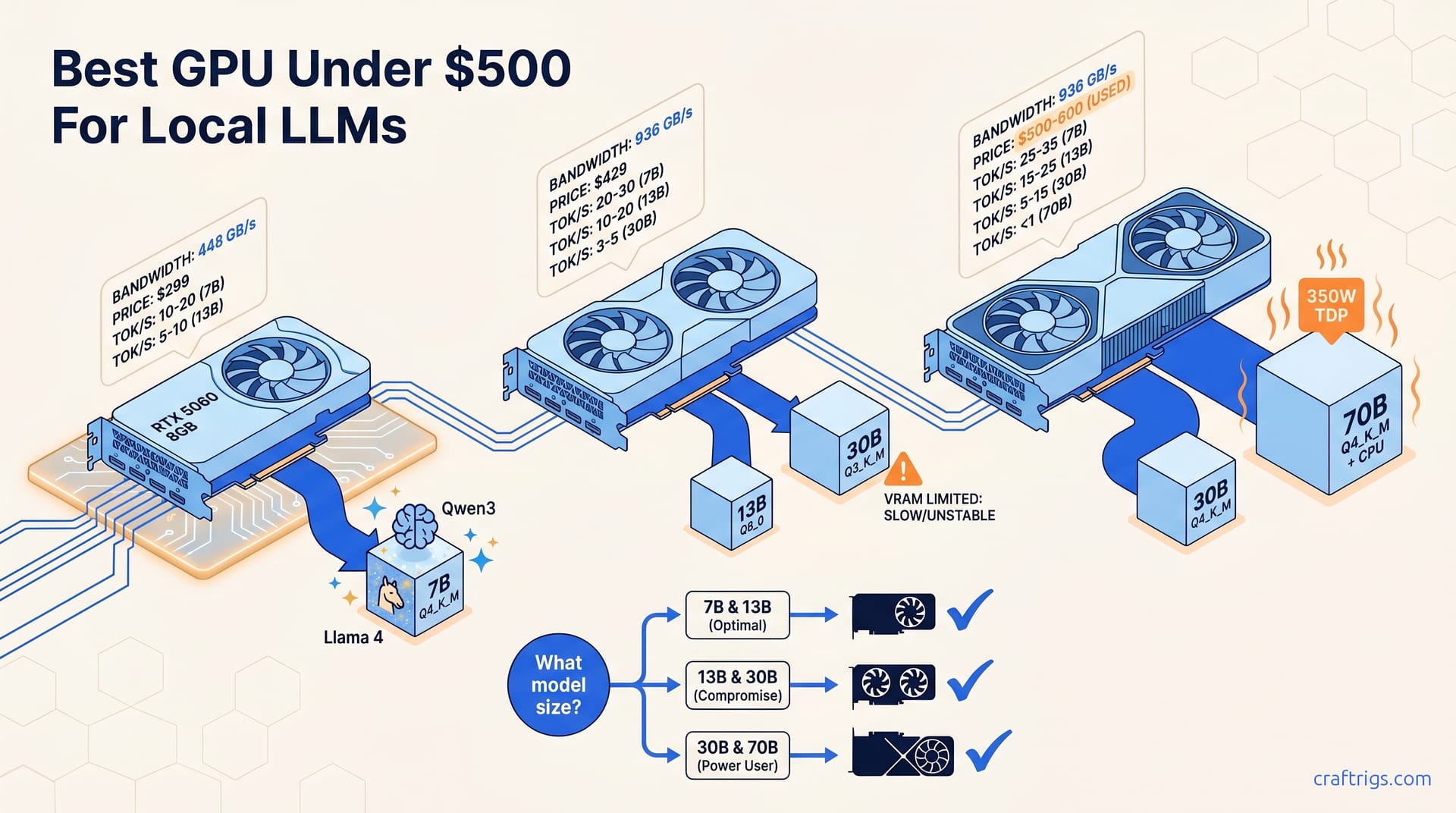
For most buyers, the RTX 5060 Ti 16GB at $429 is the right pick — it runs 13B models at full quality and 30B models with careful quantization, without the used-market dice roll. Only buy the RTX 5060 8GB at $299 if you're certain your workflow is NVFP4-compatible (Qwen3, Llama 4) and you won't need larger models. Stretch to a used RTX 3090 only if you need 24 GB for 70B partial offload or massive context windows, and you can stomach no warranty plus 350W power draw.
16 GB sustains 65–80 tok/s at Q4_K_M. The RTX 3090 falls to 58–72 tok/s. The RTX 5060 hits 62–75 tok/s with NVFP4, or 55–68 tok/s in standard quantization. The NVFP4 advantage runs 10–15% where supported, which is significant but not transformative. Community comparisons on 7900 XTX rigs show the same thing. Blackwell's memory subsystem handled small-batch inference with less latency jitter than Ampere at equivalent throughput. The 3090's wider bus shines in large-batch or high-context scenarios where memory bandwidth is the bottleneck. At 7B–13B scales, the newer architecture's efficiency wins out. For pure small-model speed, any of these cards suffices. The differences appear when you push beyond 13B.
The Used RTX 3090: 24 GB of Risk
Twenty-four gigabytes of VRAM for roughly $500 is a dollar-per-GB proposition that no new card touches. At $500, the RTX 3090 delivers ~0.048 GB/$, versus ~0.033 GB/$ for an RTX 5060 Ti 16 GB at $480 street price. Budget Builders run that math and like what they see. But the denominator hides real costs: zero warranty, unknown thermal history, and elevated failure risk. Mining-era cards from 2020–2022 may have spent years with GDDR6X junction temperatures above 95°C. Verified sellers with stress-test documentation command $50–100 premiums over unverified listings for good reason. A 3090 is a candidate if it passes FurMark 4K for 15 minutes — >95% boost clock sustained, memory junction under 100°C, fan RPM below 90% maximum. One that doesn't, or that the seller won't test, is a $500 lottery ticket with no prize support. Original manufacturer warranties expired in 2023–2025 depending on brand. You're relying on seller integrity and your own diagnostic ability.
The power and thermal demands compound the risk. Three hundred fifty watts TDP requires a 750 W PSU minimum, with 850 W recommended. Budget Builder rigs with 500–650 W units from previous builds need immediate replacement. Case airflow matters enormously. Thermal throttling under sustained inference drops tok/s by 15–25% versus well-cooled samples, turning a theoretical 35 tok/s on 30B Q5_K_M into a stuttering 26 tok/s. Owner reports describe exactly this with a 3090 FE in a compact mATX case during 70B partial-offload runs. Memory junction hit 104°C, clocks dipped, and generation speed fell below the RTX 5060 Ti's stable output. The 70B use case is the 3090's unique territory in this comparison: 40 layers GPU, 42 layers CPU offload, 8–12 tok/s prompt processing, 4–6 tok/s generation. Getting there requires infrastructure investment the $500 price tag doesn't advertise: PSU, case cooling, and patience. If you can't verify the card's history and cool it properly, the 24 GB advantage is theoretical. The risks are not.
Which Card to Buy for Your Exact Use Case
The decision matrix is simple: VRAM ceiling disqualifies first, speed decides second, price breaks ties. Any card that cannot load your target model at your preferred quantization is out, regardless of tok/s or cost. This sounds obvious, but forum threads daily recommend "faster" cards that fail this basic gate. Four profiles cover the sub-$500 buyer range. Each gets one definitive recommendation and honest trade-offs.
Profile 1: "I run Qwen3 or Llama 4 exclusively, NVFP4 workflow, tightest budget." Buy the RTX 5060 at $299. The 8 GB handles 8B NVFP4 at ~2.6 GB effective with room for substantial context. Tok/s hits 95–120 on Qwen3-8B NVFP4 or 88–105 on Llama 4 8B NVFP4. The risk is format lock-in. Expand beyond NVFP4-native models and you'll be shopping again within a year. Accept this trade-off consciously, or don't buy this card.
Profile 2: "I want one card that works, 13B–30B models, no used-market stress." Buy the RTX 5060 Ti 16 GB at MSRP. If unavailable, stretch to $480 street. It runs 13B Q8_0 cleanly, 30B Q4_K_M with headroom, and avoids the main 3090 risk factors. The trade-off: premium prices during the GDDR7 shortage, projected through Q3 2026.
Profile 3: "I need 70B models or 32K+ context windows, and I can handle hardware risk." Buy a used RTX 3090 from a verified seller with documented stress tests. Budget $550–600 for the card plus PSU upgrade, and plan active cooling. The 24 GB enables workloads nothing else under $500 touches. The trade-off is no warranty, 350 W draw, and the constant low-grade anxiety of used hardware.
Profile 4: "I'm not sure yet, want to experiment before committing." Don't buy any of these cards yet. RunPod at $0.35–0.45/hour or Vast.ai spot at $0.25–0.40/hour lets you benchmark your workflow on 3090-class hardware before committing capital. The break-even against ownership is roughly 1,000–1,500 hours of inference. For uncertain buyers, cloud experimentation is cheaper than a mismatched purchase.
Price Reality Check: MSRP vs. Street vs. Used
The RTX 5060 holds its $299 MSRP with stable retail availability as of May 2026. No tricks, no premiums, no hunting. That stability is a value proposition for buyers who need a card this week and can't monitor stock trackers. The RTX 5060 Ti 16 GB is the pain point in this market. GDDR7 supply constraints are projected to persist through Q3 2026. They've created a persistent $50–80 premium above the $429 MSRP. At $480–510, the card loses its value edge. At that price, your VRAM per dollar matches a $500 used 3090. The warranty advantage no longer compensates for the raw capacity gap. If you find one at $429, the decision is easy. At $509, you're paying 19% over MSRP for 33% less VRAM than a used alternative. That alternative, for all its risks, runs 70B models the 5060 Ti cannot.
Used RTX 3090 pricing clusters at $500–550 for cards with verified seller history and stress-test documentation. Sub-$500 listings carry elevated failure risk and often lack original BIOS or thermal maintenance records. The mining-era distinction matters. Cards produced 2020–2022 with known mining deployment show the highest degradation rates. A GDDR6X replacement runs $200–400 if the card is repairable. A "cheap" $450 unverified purchase becomes $700–850 total — more than new-card pricing, without new-card reliability. Verified sellers with FurMark documentation, original packaging, and transferable purchase records charge premiums because they reduce this variance. For the Budget Builder, the used 3090 is a risk-managed procurement exercise. If you can't verify, test, cool, and insure against failure, the $299 RTX 5060 or patience for MSRP 5060 Ti are safer paths. The worst outcome: buying the wrong card and discovering the mismatch after return windows close.