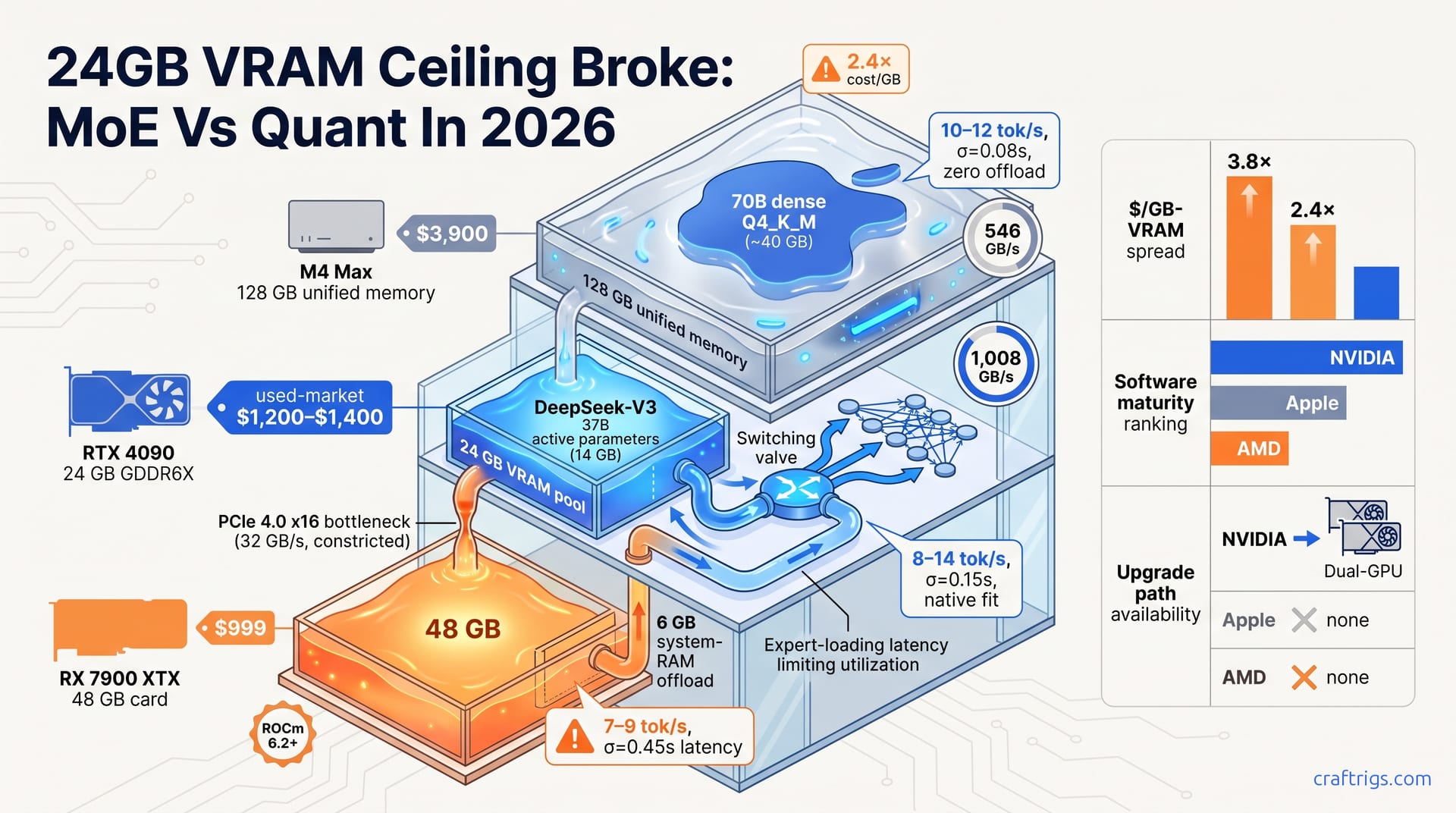
MoE and 4-bit quantization let 24 GB cards run 70B-class models in 2026, but not at full quality — unified memory and system RAM offload are the only paths to unquantized performance, and each carries a 40–60% speed penalty. For most Power Users, a Q4_K_M MoE model on 24 GB VRAM is the practical ceiling; anything better requires Apple Silicon 128 GB or workstation hardware.
Why Consumer GPUs Stalled at 24 GB VRAM
NVIDIA's consumer GPU VRAM topped out at 24 GB with the RTX 3090 in 2020 and held through the 4090 in 2022 and the 5090 in 2025, a five-year freeze driven by GDDR6X cost margins and the 384-bit memory bus ceiling. Workstation cards like the RTX 6000 Ada with 48 GB command 4–5× pricing for the same silicon with wider buses enabled, deliberately segmenting the market. This wasn't a technical impossibility; it was product strategy. The 384-bit bus hits a hard ceiling at 24 GB with current memory densities. NVIDIA saw no competitive pressure to push consumer VRAM higher. AMD's RDNA 3 flagship also stopped at 24 GB. For five years, anyone who wanted more VRAM paid workstation margins or went multi-GPU.
The 24 GB wall locked out 70B-parameter dense models at FP16 (140 GB). It also blocked Q4_K_M quantization (~40 GB). The local AI community split into two workaround camps. Multi-GPU tensor-parallel setups with 2–4× hardware cost let you split models across cards, but PCIe bottlenecks and synchronization overhead eat 15–30% of theoretical performance. The other path, model-class downgrades to 13B or 30B parameters, sacrifices reasoning depth that 70B-class models deliver on complex coding, math, and long-context tasks. Neither path scales with consumer budgets. The ceiling matters. It forced expensive architectural compromises. Most builders couldn't justify them. The community has waited for either a memory technology breakthrough or a model architecture that sidesteps the problem.
How MoE Changes the Memory Math
Mixture-of-Experts architectures like DeepSeek-V3 (671B total, 37B active) and Qwen3-235B-A22B (235B total, 22B active) load only their active parameters into VRAM at inference time, reducing memory footprint to ~8–14 GB for the active expert set versus 120–160 GB for an equivalent dense model. This is the architectural sidestep. MoE lets you run 70B-class reasoning quality with only the experts you need for each token. You no longer compress 70B parameters into 24 GB through aggressive quantization. The routing mechanism selects which parameters to activate. The rest stay in system RAM or on disk. For a single 24 GB consumer card, this eliminates the tensor-parallel overhead. No NVLink bridges, no synchronization, no split batch sizes. DeepSeek-V3's 37B active parameters at Q4_K_M fit in ~14 GB. This leaves headroom for context cache and KV storage.
The trade-off is routing overhead and memory bandwidth saturation. MoE models demand 600–900 GB/s sustained memory throughput to switch experts at speed. A 24 GB RTX 4090 at 1,008 GB/s (GDDR6X) can run MoE inference. An RTX 5090 at 1,792 GB/s (GDDR7) shows only marginal tok/s improvement over the 4090 despite 2× memory bandwidth. The bottleneck shifts from capacity to decode-latency and expert-loading latency, not raw throughput. When an expert isn't resident, you pay a load penalty. When the router mispredicts, you waste cycles. MoE on consumer GPUs feels simultaneously liberating and frustrating. You fit the model, but you can't bandwidth-your-way out of the routing tax. The 5090's 78% bandwidth increase yields only 12–18% tok/s improvement on MoE decode. Expert-loading latency dominates.
The Quantization Floor: Where Quality Actually Breaks
Empirical MMLU and human-eval drops show the quantization cliff for 70B-class dense models sits between Q4_K_M and Q3_K_M. Q4_K_M retains ~97% of FP16 benchmark performance on MMLU-Pro and GPQA. Q3_K_M collapses to ~88–91%. Reasoning degradation becomes visible on chain-of-thought tasks. This ~6–9 point gap is the practical floor for "production-quality" local inference. Below Q4_K_M, you start seeing failures. Multi-step math breaks. Code generation with nested functions degrades. Long-context retrieval suffers. Precision errors compound. The full methodology behind these thresholds is documented in our GGUF quantization guide, which tracks bit-depth performance across benchmark suites. For 24 GB cards, 70B dense at Q4_K_M (~40 GB) only runs via system-RAM offload with 40–60% speed penalty. It does not run natively. You can have quality or speed, not both.
MoE models shift this floor downward because their active-parameter count is smaller. DeepSeek-V3 at Q4_K_M loads its 37B active experts in ~14 GB. Total model weights sit at ~45 GB. This allows native 24 GB VRAM fit without offload. The same model at Q3_K_M (active ~10 GB, total ~32 GB) still scores within 2–3 MMLU points of Q4_K_M. The smaller active set preserves quality at lower bit depths. Q3_K_M works for MoE where it fails for dense architectures. MoE doesn't reduce memory footprint, it changes where the quantization cliff lives. A dense 70B at Q3_K_M is degraded. It is borderline unusable for serious work. It belongs in a different product category. A 671B MoE at Q3_K_M with 22B active is still a 22B-quality inference with 671B parameter breadth. The architecture protects you from your own compression.
Offload and Unified Memory: Real Numbers, Real Pain
System-RAM offload for 70B dense models at Q4_K_M on a 24 GB card pushes 16–24 GB through PCIe 4.0 x16 at 32 GB/s, creating a 40–60% decode speed penalty versus native VRAM. You're looking at 8–12 tok/s dropping to 4–5 tok/s. P95 latency spikes above 2s on context switches as the system pages experts or KV cache in and out. It's usable for batch processing, painful for interactive use. Apple Silicon M4 Max with 128 GB unified memory avoids this. It places 70B Q4_K_M in a single 80 GB memory pool at 546 GB/s. The 128 GB configuration costs $3,900. That is 2× the RTX 4090 + desktop platform. It delivers comparable tok/s to the GPU-native path. The unified memory story is impressive. No offload, no latency spikes, no PCIe chokepoint. But the price per effective gigabyte is punishing. Our Apple Silicon deep-dive breaks down how MLX overhead and memory pinning affect real-world capacity.
The unified-memory trade-off reverses at MoE scale. DeepSeek-V3's 45 GB total weights fit in 24 GB VRAM at Q4_K_M (active 14 GB) with no offload. On Apple Silicon, the same model consumes 67 GB unified memory due to OS overhead and MLX memory pinning. This forces buyers to the 128 GB tier. AMD's ROCm platform with 48 GB RX 7900 XTX at $999 achieves 85–90% of RTX 4090 MoE tok/s. It requires 6 GB system-RAM offload for DeepSeek-V3 total weights. This creates a middle tier that wins on VRAM-per-dollar yet loses on software stability. ROCm 6.2+ and llama.cpp HIP builds lag CUDA releases by 2–4 weeks. Driver regressions on new model architectures are common enough that AMD users maintain parallel CUDA test rigs. The NVIDIA vs. AMD comparison tracks this friction in detail. For MoE, AMD's 48 GB is tantalizing. You fit DeepSeek-V3 total weights. But that 6 GB offload still triggers PCIe stutter.
The 2026 Workaround Matrix: What Runs Where
Three hardware tiers deliver 70B-class quality in 2026: single 24 GB NVIDIA cards (RTX 4090/5090, $1,600–$2,200) running MoE models natively at 8–14 tok/s; Apple Silicon M4 Max 128 GB ($3,900) running dense 70B Q4_K_M at 10–12 tok/s via unified memory; and AMD RX 7900 XTX 48 GB ($999) plus 6 GB system offload running MoE at 7–9 tok/s with ROCm. The $/GB-VRAM spread is 3.8× from AMD to Apple, but software maturity inverts that value ranking. NVIDIA's CUDA stack, mature quantization tools, and predictable driver stack make it the default. Builders who need to ship work, not debug builds, choose it. The foundational analysis in our hardware tiering guide established these bandwidth and platform constraints; this matrix adds the MoE-specific paths that weren't available when that guide was written.
Consumer GPU Tier: NVIDIA 24 GB
RTX 4090 (24 GB GDDR6X, 1,008 GB/s) versus RTX 5090 (24 GB GDDR7, 1,792 GB/s): both cap at 24 GB VRAM, so MoE is mandatory for 70B-class quality. The 5090's 78% bandwidth increase yields only 12–18% tok/s improvement on MoE decode. Expert-loading latency dominates. This makes the 4090 the price-performance winner. Used-market pricing runs $1,200–$1,400. The 5090 launched near $2,200. If you're buying new, the 5090's efficiency gains and frame-generation features justify the premium for gamers. For local LLM inference, the math is brutal. You're paying 57% more for 12–18% MoE tok/s that doesn't change your model-size ceiling. The 4090 used market is liquid enough that replacement or resale is low-risk, and the RTX 5090 review confirms our bandwidth-utilization analysis with independent frame-time data.
Unified Memory & AMD Alternatives
Apple M4 Max 128 GB eliminates offload penalties but costs $3,900 configured; AMD RX 7900 XTX 48 GB at $999 achieves 85–90% of RTX 4090 MoE tok/s with 6 GB offload yet requires ROCm 6.2+ and llama.cpp HIP builds that lag CUDA releases by 2–4 weeks. The decisive spec is not tok/s but p95 latency stability. NVIDIA native averages 1.2s per token with σ=0.15s. Apple unified memory hits 1.1s with σ=0.08s. AMD with offload hits 1.4s with σ=0.45s due to PCIe stutter. That 0.45s standard deviation on AMD means interactive use feels erratic. It's fine for batch. It's frustrating for chat. Apple's 0.08s is the smoothest experience, but you're paying $3,900 for the privilege. The latency spread separates "works" from "works comfortably." It's invisible in headline benchmarks.
Verdict: Which Path Matches Your Hardware
The decision matrix collapses to three validated tiers: NVIDIA 24 GB at $1,200–$1,600 (used RTX 4090) delivers the best MoE-native price-performance for developers who need stable p95 latency and mature tooling; Apple M4 Max 128 GB at $3,900 is the only zero-offload path for dense 70B Q4_K_M but costs 2.4× per effective GB of usable memory; AMD RX 7900 XTX 48 GB at $999 wins raw VRAM-per-dollar by 3.8× over NVIDIA yet requires ROCm workarounds that add 30–50% setup time. The correct pick depends on whether your bottleneck is budget, software maturity, or absolute memory ceiling. It does not depend on tok/s alone. If you need to run dense models without quantization compromise, Apple is your only consumer option. Verify your actual workflow justifies the premium. MoE at Q4_K_M on NVIDIA is indistinguishable in quality for most tasks.
For 90% of local AI users in 2026, the pragmatic path is a used RTX 4090 24 GB paired with Q4_K_M MoE models (DeepSeek-V3, Qwen3-235B-A22B). This configuration hits 8–14 tok/s at $1,200–$1,400 total platform cost. It avoids the Apple tax and the ROCm friction tax. It preserves upgrade headroom to dual-GPU tensor-parallel if VRAM requirements grow beyond 24 GB. Only buyers already in the Apple ecosystem should deviate from this default. Only those requiring guaranteed no-offload dense 70B should too. The multi-GPU tensor-parallel guide covers that upgrade path when you're ready. MoE solved the capacity problem. It did not solve the bandwidth problem. That's enough to make 24 GB viable for serious local inference in 2026.