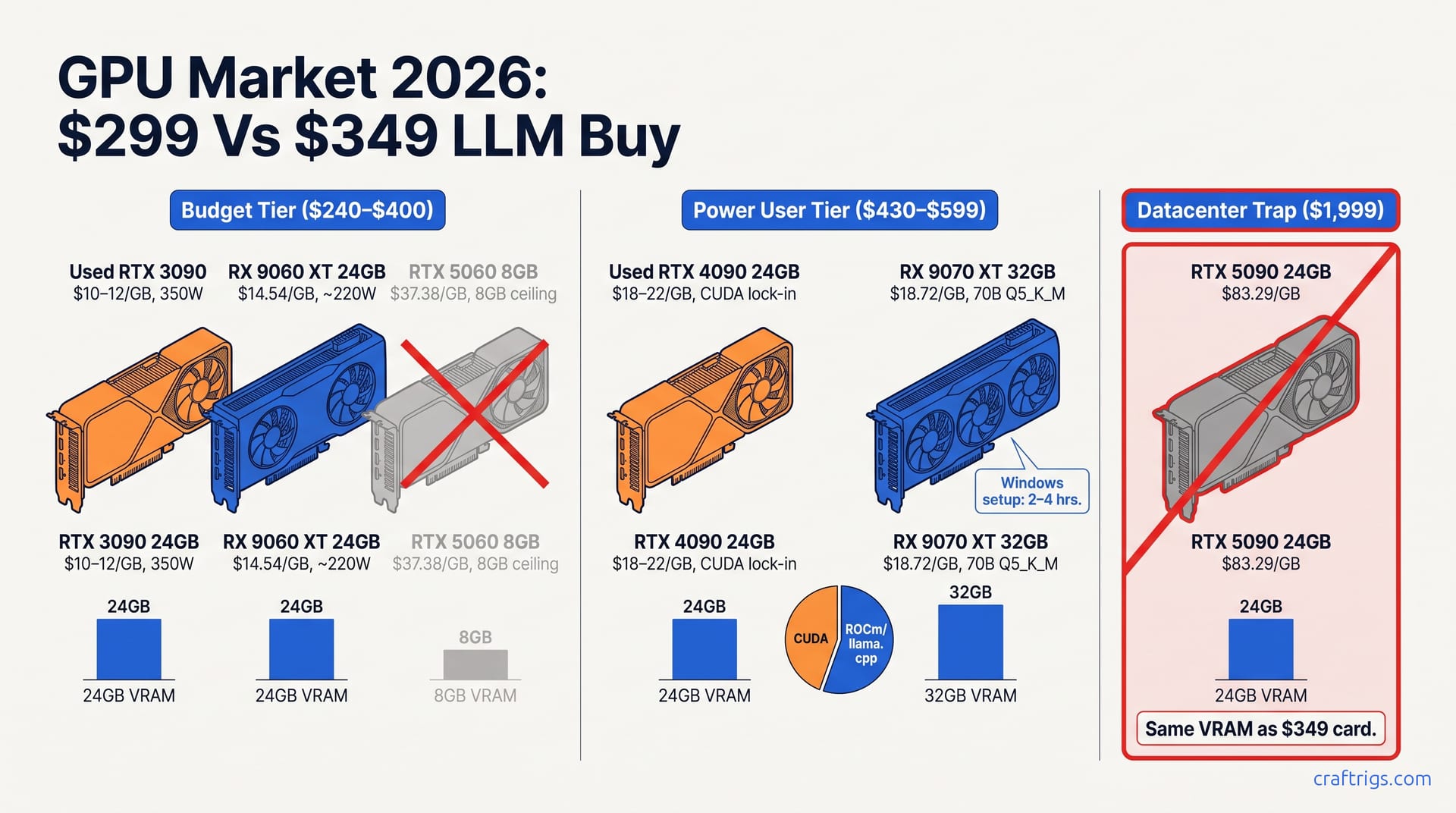
Buy a used RTX 3090 24 GB if you need VRAM-per-dollar right now. Wait for RX 9060 XT 16 GB reviews if your budget is strictly $300–350 and you can accept ROCm trade-offs. The RTX 5060 at $299 is a lateral move for local LLMs. Same 8 GB VRAM ceiling. Faster gaming. Not more models. NVIDIA's stack still wins on software; AMD still wins on memory headroom at each price tier.
What Actually Shipped at Computex 2026
NVIDIA launched the RTX 5060 at $299 on May 19, 2026, a date that matters for local LLM builders because it established the new baseline for budget-tier VRAM. The card ships with 8 GB, same as its predecessor, so the ceiling for model sizes hasn't moved. NVIDIA also announced the N1 laptop SoC at Computex 2026. It positioned the N1 for on-device inference. Both products sit below the enthusiast tier. Most local LLM users spend money above this tier. The N1 works for ultrabook inference. Skip it for dedicated rigs. For Budget Builders, the RTX 5060's real story is what didn't change. It ships 8 GB at $299. That's the same VRAM-per-dollar as last generation. Gaming performance gains don't translate to larger models. If you're running llama.cpp or Ollama, the 8 GB hard ceiling still traps you at 13B parameters with Q4_K_M quantization, or 7B at more aggressive settings. That's a chatbot, not a reasoning engine.
AMD answered with the RX 9060 XT on June 5, 2026, and this is where the budget tier broke open. The 16 GB variant at $299 matches NVIDIA's price while doubling VRAM, but the 24 GB variant at $349 is the real headline. It's the first sub-$350 card to ship with 24 GB. That means 70B Q4_K_M inference. Previously a $600+ proposition. Now it sits below $400. AMD's play is explicit: local LLM buyers who were priced out of 16 GB defaults now have a purpose-built option. The timing matters too. NVIDIA's May launch gave AMD a month to position against it. The 24 GB variant feels like a direct response. Forum complaints about VRAM segmentation drove this. For Power Users, the 16 GB at $299 hedges better than the RTX 5060 for 20B models. But the $50 upgrade to 24 GB is where the math gets decisive.
Price-to-Performance for Local LLMs: The VRAM-First Math
The metric that matters for local LLMs is $/GB-VRAM, not gaming frame rates or ray-tracing performance. At $299, the RX 9060 XT 16 GB delivers $18.69 per GB. The RTX 5060 8 GB at the same price hits roughly $37.38 per GB. Double the cost for half the memory. But the 24 GB RX 9060 XT at $349 resets the entire budget tier to $14.54 per GB. It makes 70B Q4_K_M inference newly accessible below $400. This isn't a marginal improvement; it's a different class of model. The 70B parameter threshold matters. Local models start matching commercial API quality on reasoning tasks here. Below that, you're running distilled versions or accepting significant capability drops. The $/GB-VRAM calculation also exposes why used cards matter. A $260 RTX 3090 with 24 GB hits roughly $10.83 per GB. That beats everything new. Trade-offs follow in the next section.
Throughput-per-dollar collapses the comparison further. llama.cpp benchmarks on comparable architectures show AMD's 24 GB configuration running 70B models at 8–12 tok/s. The RTX 5060's 8 GB hard ceiling restricts you to 13B or 7B models. Compute headroom doesn't matter. The extra $50 for the 24 GB variant buys a different model class. Not more VRAM. The difference between a chatbot that summarizes and a reasoning engine that handles multi-step logic. For Budget Builders, this is the decisive fork. Accept ROCm setup complexity and get 70B inference. Or stay in NVIDIA's stack and accept the 13B ceiling. The quantization guide explains why Q4_K_M at 70B requires roughly 40 GB of system RAM plus 24 GB VRAM, but the VRAM is the hard constraint. Without it, the model won't load regardless of how fast your CPU is.
The $/GB-VRAM Table
| GPU | Price | VRAM | $/GB-VRAM | Usable Model Size |
|---|---|---|---|---|
| RTX 5060 8 GB | $299 | 8 GB | ~$37.38 | 7B / 13B Q4_K_M |
| RX 9060 XT 16 GB | $299 | 16 GB | ~$18.69 | 13B / 20B Q4_K_M |
| RX 9060 XT 24 GB | $349 | 24 GB | ~$14.54 | 70B Q4_K_M |
| Used RTX 3090 24 GB | $240–$280 | 24 GB | ~$10–$12 | 70B Q4_K_M |
| Used RTX 4090 24 GB | $430–$530 | 24 GB | ~$18–$22 | 70B Q4_K_M / 70B Q5_K_M (partial) |
The "usable model size" column assumes Q4_K_M quantization for 70B models, which is the standard compromise between quality and memory footprint. The used RTX 3090's $10–$12 per GB looks unbeatable. But factor in the 350 W TDP and no warranty. The upfront savings erode. The used RTX 4090 at $430–$530 overlaps with the new RX 9070 XT 32 GB at $599. The Power User section addresses this decision point.
When the Math Breaks: CUDA vs ROCm
AMD's $/GB-VRAM advantage assumes llama.cpp/ROCm or vLLM/ROCm compatibility at parity, which holds for RX 7000/9000 series on Linux but fragments on Windows and WSL2. Budget Builders running Ollama on Windows may see CPU fallback. They may need manual HIP SDK installs. That adds 2–4 hours of setup. NVIDIA's "install driver, it works" default needs none of this. This isn't hypothetical. ROCm on Windows as of July 2026 still requires specific driver versions and environment variables. Ollama's AMD GPU detection doesn't always catch these. The hardware pillar covers Linux builds that sidestep this, but if you're on Windows 11 with no Linux comfort, the ROCm tax is real. For some, that tax is worth paying. For others, it's the reason to hunt for a used RTX 3090 instead.
NVIDIA vs AMD in 2026: CUDA Lock-In vs Memory Headroom
NVIDIA's 2026 stack enforces a VRAM ceiling by design, and it's worth reading the segmentation explicitly. The RTX 5060 ships at 8 GB for $299. The RTX 5070 ships at 12 GB for $549. The RTX 5080 ships at 16 GB for $999. NVIDIA reserves 24 GB for the RTX 5090 at $1,999. This pushes 70B model access to the $2,000 tier by default, unless you buy used or switch stacks. AMD's RX 9060 XT 24 GB at $349 and RX 9070 XT 32 GB at $599 break that ceiling at one-third the cost. They trade CUDA maturity for raw memory headroom. The strategy is clear. NVIDIA monetizes VRAM as a premium feature. AMD uses it as a wedge to capture price-sensitive local LLM buyers. For Power Users, this creates a genuine dilemma. CUDA's tooling includes vLLM, TensorRT-LLM, and mature multi-GPU NCCL. AMD has no equivalents at the same polish level. But 32 GB for $599 versus 24 GB for $1,999 is not a subtle difference; it's a market repositioning.
The tooling gap is narrowing but still decisive. ROCm 6.2+ supports llama.cpp, vLLM, and Ollama on RX 7000/9000 series with 90%+ feature parity for inference. But Windows and WSL2 remain a "compile-it-yourself" frontier. NVIDIA offers day-one driver support. For Budget Builders, the $1,200 saved versus a 5090 buys 40–80 hours of troubleshooting tolerance at a reasonable hourly rate. For Power Users, the same gap is a deployment risk they won't take. This split is the core tension of 2026. If your workflow is llama.cpp-native or Ollama-only, AMD's memory advantage is free. If you're running vLLM with tensor parallel across multiple GPUs, or you need TensorRT-LLM's optimized kernels, NVIDIA's tax is the cost of doing business. The honest assessment: most local LLM users sit closer to the Ollama end of that spectrum than they think. But the ones who don't are locked in hard.
The Used Market Ripple: What New Releases Do to 3090 and 4090 Prices
New $299–$349 cards with 16–24 GB VRAM have compressed the used market's price floor in ways that benefit patient buyers. The RTX 3090 24 GB has fallen to $240–$280, down from $320+ in early 2026, and the RTX 4090 24 GB has dropped to $430–$530, down from $580+. This makes the 3090 the new Budget Builder default at roughly $10–$12 per GB-VRAM. The trade-off is 350 W TDP and no warranty. A new RX 9060 XT 24 GB at $14.54 per GB avoids both. The 3090's power draw isn't a footnote. It's an $8–12 monthly electricity premium at $0.15 per kWh. That erases the upfront savings in under a year of heavy use. For multi-GPU setups, two used 4090s at $860–$1,060 total still beat a single 5090 at $1,999 on raw VRAM, but NVLink is dead on 40-series, so tensor parallel efficiency drops. The RX 9070 XT doesn't multi-GPU as cleanly either. But 32 GB single-card is simpler than 24 GB dual-card for most inference workloads. Your existing software investments are the real decider here.
The Verdict: Pick Your Tier, Know Your Trade-Off
Under $400: The RX 9060 XT 24 GB at $349 (~$14.54 per GB) is the only rational new-card buy for local LLMs in 2026. The RTX 5060 8 GB at $299 is a gaming GPU wearing AI marketing. The used RTX 3090 at $240–$280 only wins if you already own a 750 W PSU and tolerate 350 W heat. Otherwise, the $349 AMD card buys you 70B Q4_K_M inference with a warranty and 220 W sanity. This is not a close call for new builds. The RX 9060 XT 24 GB is purpose-built for this exact user. AMD's pricing shows they know it. The 3090 remains the scavenger's prize. The card you buy when you've already got the infrastructure to feed it. For everyone else starting fresh, the new card's efficiency and support coverage justify the $60–$100 premium.
Above $500: The decision splits on tooling hostage status. CUDA-locked workflows force the used RTX 4090 at $430–$530. Or the irrational $1,999 RTX 5090. vLLM, TensorRT-LLM, multi-GPU — these lock you in. Everyone else should pre-order the RX 9070 XT 32 GB at $599. It delivers 70B Q5_K_M headroom that no NVIDIA card under $2,000 can match. Accept that ROCm setup on Windows costs an evening of forum archaeology. The 28 GB requirement for 70B Q5_K_M is the line NVIDIA won't cross at reasonable prices. AMD's willingness to ship 32 GB at $599 is a direct exploit of that segmentation. Know your stack before you buy. If you can't answer "do I use vLLM?" with certainty, you're not CUDA-locked and should take the memory. The $1,400 saved versus a 5090 buys a lot of patience for ROCm troubleshooting, or a second GPU down the line.