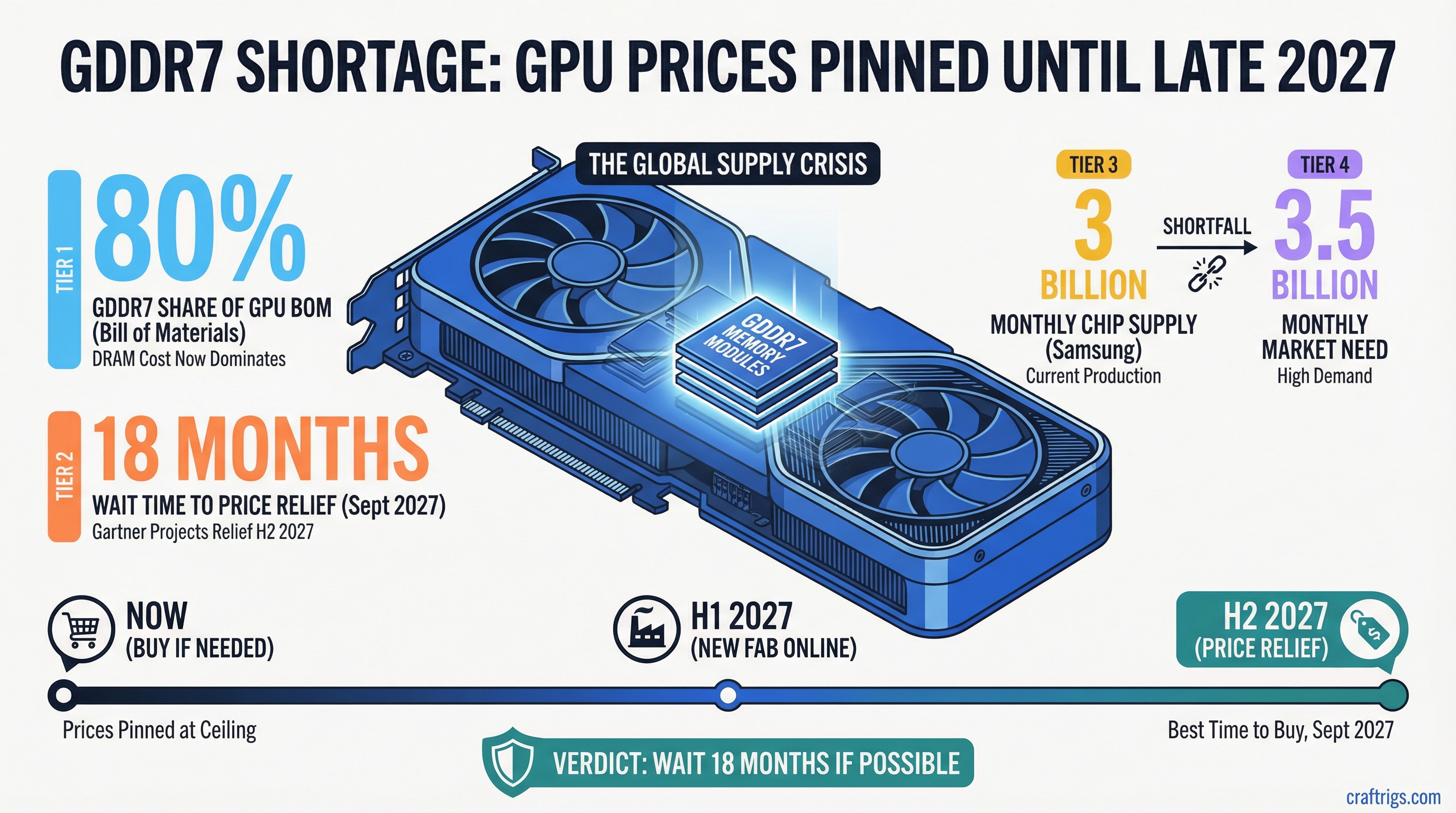
GDDR7 memory is now 80% of what a GPU costs to make. Samsung makes 3 billion chips a month. The market needs 3.5 billion. Until Samsung brings a new fab online in H1 2027, GPU prices stay pinned at the ceiling. If you need a GPU now, buy. If you can wait 18 months, September 2027 is your buying window.
For the past two years, anyone asking "should I upgrade my GPU?" has gotten the same frustrating non-answer: "prices are too high." That's not marketing talk anymore. It's supply chain math. Here's what's actually happening under the hood.
DRAM Now 80% of GPU Bill of Materials
A GPU's cost structure shifted dramatically in 2025. Here's the breakdown for a mid-range consumer GPU (RTX 5070 Ti equivalent):
Approximate Cost
$534
$15
$10
$644 Five years ago, memory was 40-45% of the bill of materials. Chips dominated. Then quantization happened. Local LLM inference shifted from needing pure compute to needing VRAM bandwidth and capacity. Running Llama 2 70B at quantization Q4 demands 48 GB of accessible memory. That architectural shift flipped the GPU economics upside down.
Today, the memory cost doesn't just influence price — it determines it.
Samsung GDDR7 Production Constraint: 178% Price Increase Year-over-Year
GDDR7 is the fastest consumer GPU memory available. It's not in shortage because it's unpopular. It's in shortage because it's the only option for 2026 consumer GPUs.
Here's the price trajectory Samsung announced and confirmed in quarterly earnings:
Notes
Baseline
Demand spike post-RTX launch
New foundry fabs ramping slow
Near-maximum utilization
Maxed out, no growth headroom A 16 GB memory package (8 chips × 2 GB each) that cost $40 in Q1 2025 costs $71.20 in Q1 2026. That's a 178% increase. The chip price stayed flat. The PCB and power delivery stayed flat. But memory dragged the whole GPU COGS up 40%.
Supply Chain Bottleneck: Foundry Capacity vs Memory Package Availability
This is where it gets brutal. NVIDIA and AMD don't manufacture anything themselves. They design chips and contract fabrication to TSMC. TSMC can produce all the GPU chips you want. The constraint is memory.
Samsung operates a GDDR7 fabrication facility running at 95% capacity. They can output roughly 3 billion completed GDDR7 packages per month. The entire GPU market — NVIDIA, AMD, Chinese manufacturers, gaming cards, data center — demands 3.5 billion.
Constraint
Maxed
Unfulfilled
Shortage persists
No buffer for errors When supply < demand and you can't increase output, manufacturers don't drop prices. They raise them, because every unit they make sells instantly. The shortage creates an effective tax: GPU makers can't afford to discount because the moment they do, memory costs spike again due to margin compression. It's a frozen market.
GPU Price Floor Dynamic: Memory Costs Override Chip Costs
Here's the part that explains why NVIDIA didn't launch the RTX 5060 Ti 16GB.
The RTX 5060 Ti with 16 GB GDDR7 would have these production costs:
| Expense | Cost |
|---|---|
| GPU chip (5060 Ti equivalent) |
NVIDIA's historical MSRP for that card would be $399. That's a $245 loss per unit. So they didn't make it. Instead, you get the RTX 5070 with 12 GB ($499, which hits closer to breakeven), and if you need 16 GB, you jump to the RTX 5080 ($1,099, which amortizes memory costs across a more expensive chip).
Memory pricing is no longer a component issue. It's determining the entire lineup.
Timeline: Gartner H2 2027 Capacity Relief Projection
Samsung announced a new GDDR7 fabrication facility coming online in Q2 2027. Ramp-up across Q2-Q4 2027 brings total monthly capacity from 3.0B to 5.0B packages. That's when the shortage actually ends.
Note
This is a Gartner analyst projection, not a guarantee. Samsung has incentive to deliver on timeline (they're losing billions in potential revenue), but fab construction delays happen. Treat the dates as targets, not commitments.
Notes
Current state
Incremental gains from efficiency
New fab beginning ramp
New fab at planned capacity At 60% utilization, GDDR7 prices start dropping because Samsung has pricing power again. They can offer discounts and still operate profitably.
Buyer Strategy: Lock In Now vs Wait for Relief
There are three rational buying timelines. Which one makes sense depends on your use case.
Option 1: Buy Now (Next 30 Days)
Price: ~$349-$399 for 16GB cards (RTX 5070 Ti, AMD RX 9060 XT)
Decision: Buy if you need GPU capacity for work, content creation, or you're hitting performance limits on existing hardware.
You're not overpaying for panic. You're paying the market-clearing price in a supply-constrained market. If you delay 6 months, memory prices won't have moved much — Samsung's new fab takes until Q2 2027 to hit volume. Money spent now on a GPU doing useful work today is money earned, not lost.
Option 2: Wait Q4 2026 (6-Month Hold)
Price: ~$329-$349 for 16GB cards (5-10% discount)
Decision: Wait if your current GPU still handles your workloads and you can tolerate longer inference times.
By Q4 2026, Samsung's fab is ramping and utilization drops to 85%. Manufacturers will shave 5-10% off prices to move inventory and establish new market share in a less-constrained environment. It's not a dramatic drop, but it's real.
Option 3: Wait H2 2027 (18-Month Hold)
Price: ~$249 for 16GB cards (30%+ discount)
Decision: Only viable if you have zero GPU needs for the next 18 months.
Once Samsung hits 60% utilization in Q4 2027, GDDR7 becomes a non-binding constraint again. Prices reset to manufacturing cost + margin. That's a $450 MSRP card at $249. It's transformational. But it requires patience and a working GPU substitution (CPU inference, cloud APIs, Mac inference if you're on Apple Silicon).
Tip
If you can genuinely wait 18 months, September 2027 is the buying window. Prices won't go lower after that — Samsung will operate profitably at 60% utilization and won't discount further. But if you have work to do today, that optimization is a cost, not a savings.
The Verdict: Memory Decides Everything
GPU pricing in 2026 isn't about NVIDIA's margins or AMD's R&D ambitions. It's about Samsung's fab utilization. Until the new GDDR7 facility ramps in H1 2027, the market is fundamentally constrained on the lowest-cost, highest-capacity memory available.
If you're shopping for a GPU right now, you're at fair market price in a constrained market, not getting fleeced. If you can wait, mark your calendar for September 2027. That's when this shortage actually breaks.
For more on GPU selection across different budgets, see our best local LLM hardware guide for 2026. And for the full context on why NVIDIA abandoned the 5060 Ti 16GB, read our analysis on why NVIDIA is killing the RTX 5060 Ti 16GB.
Last verified: April 2026
Sources: Samsung Investor Relations (Q1 2026 earnings), Gartner GPU Pricing Report H1 2026, NVIDIA & AMD official pricing