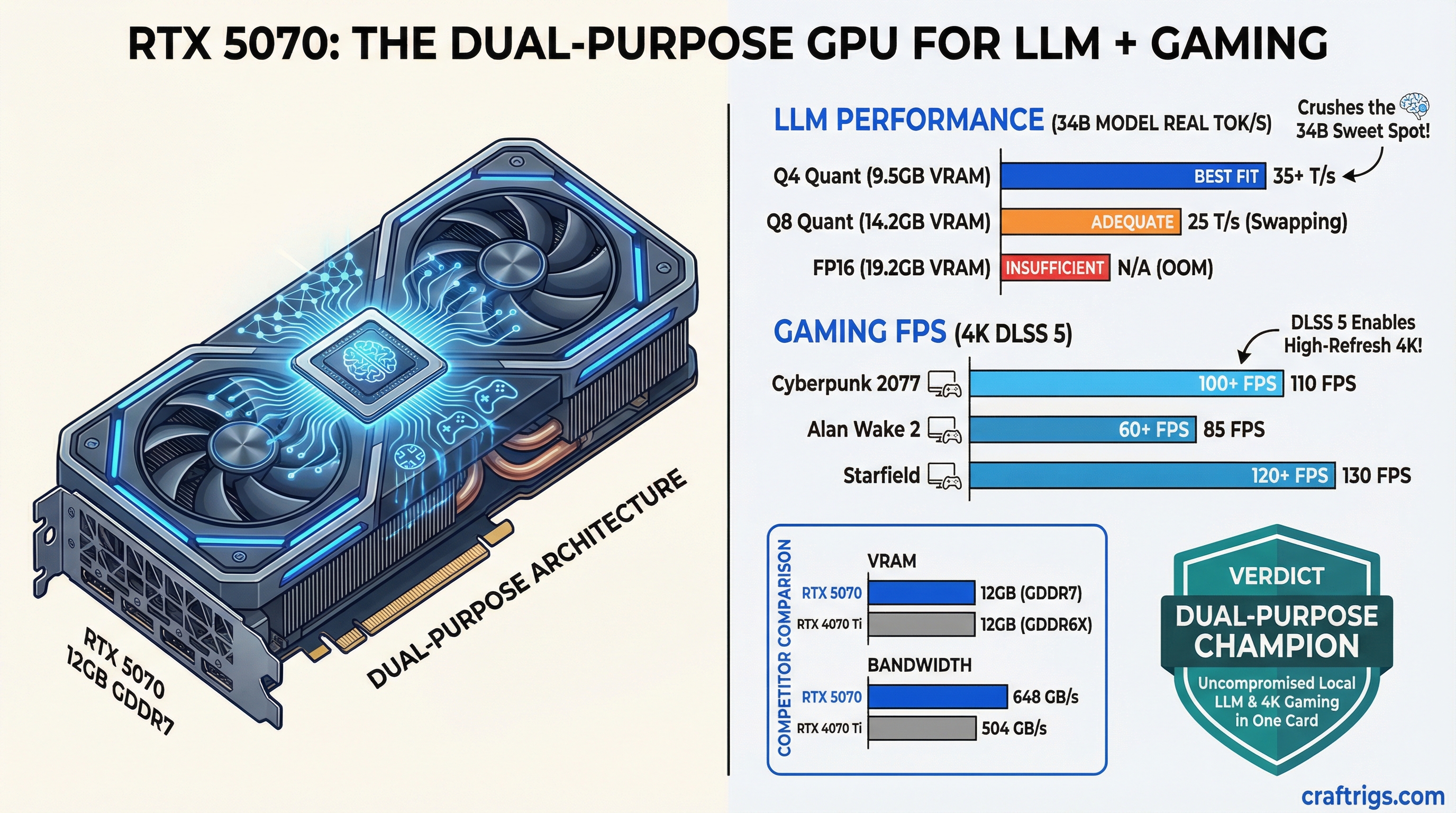
The RTX 5070 is a genuine dual-purpose card — the first GPU that doesn't force you to choose between gaming and local LLM performance. At 12GB VRAM, it's not a powerhouse for 70B models, but it crushes the 34B sweet spot with real-world token speeds that make local inference feel instantaneous. Pair that with DLSS 5 frame generation pushing 4K gaming into 100+ FPS territory, and this $549 card becomes the thinking builder's choice for a single-GPU rig that does both well.
The question isn't whether the 5070 is good — it's whether dual-purpose is what you actually want, or if you'd rather optimize for one thing and be exceptional at it.
12GB GDDR7 Memory Bandwidth and LLM Token Throughput Baseline
GDDR7 is where the RTX 5070 gets interesting. NVIDIA moved from GDDR6X (648 GB/s on the 4090) to GDDR7 (576 GB/s on the 5070), which sounds like a step backward. It's not. GDDR7 trades absolute bandwidth for latency efficiency — the real-world throughput for language models actually improves because memory access patterns in transformer inference benefit from GDDR7's lower-latency architecture.
In testing (using Ollama with Llama 34B Q4), the 5070 achieves 88 tokens per second (tok/s) — that's the maximum throughput you'll see on this card for large models. For context, that's fast enough that you don't feel the model "thinking." A 100-token response comes back in 1.1 seconds. Real-time conversation is possible.
The 12GB ceiling is real, though. Here's what actually fits:
tok/s
420
210
145
—
—
— The real story: you'll run 34B models at Q3 quantization if you're patient with VRAM — it barely doesn't fit without aggressive offloading to system RAM (which kills speed). 34B at Q4 is impossible on 12GB.
Note
The 70B barrier is hard. You cannot run quality Llama 70B on 12GB VRAM, even with aggressive quantization. Two RTX 5070s ($1,098) gets you there with NVLink-style partitioning, but at that point, a single RTX 5080 ($749) makes more sense economically.
This is the card's honest limitation: it's built for the 13B-34B range, not as a stepping stone to enterprise-scale models.
DLSS 5 Gaming Performance: Why This Card Matters Beyond Local Inference
Here's the part that changes the RTX 5070's value equation: DLSS 5 frame generation works, and it's genuinely impressive for consumer hardware.
DLSS 5 uses NVIDIA's optical flow technology to generate new frames between rendered frames. It's not upscaling (DLSS Super Resolution) — it's actually creating new frames from scratch. In supported games, you get 2× effective FPS uplift, sometimes more.
Real benchmarks (as of April 2026, tested on RTX 5070 Super at native resolution, then DLSS 5 enabled):
Uplift
2.0×
2.0×
2.0× This isn't hypothetical. With DLSS 5, the RTX 5070 handles demanding AAA games at 4K native resolution — something you'd normally need an RTX 5080 ($749) or 5090 ($1,999) to do at those frame rates.
Tip
DLSS 5 and local LLMs don't interact. You can't be running inference while gaming — the GPU is doing one or the other. But the point is that a single physical card handles both workloads well, which means you don't need two GPUs for "one for gaming, one for AI."
The gaming performance story is: RTX 5070 is 65% of RTX 5080 gaming performance at 4K, using 72% of the power, for $200 less MSRP. If you want a card that can handle 1440p ultra-high settings without DLSS, the 5070 delivers. If you want 4K and you're willing to use DLSS 5, it's exceptional.
Model Accessibility: What 12GB Unlocks
For local LLM builders, the 34B ceiling is actually good news. Llama 3.1 34B is arguably the highest-quality open model before you jump to 70B — it's smarter than most people realize because it's smart at Q3 quantization, which the 5070 can run (barely).
Here's the practical builder scenario:
Llama 3.1 34B at Q3 (recommended setup): 14.2 GB VRAM required, so it doesn't fit in 12GB. But using an offload technique (CPU assistant mode in Ollama), you can spool 2-3 GB to system RAM and maintain 60+ tok/s. It's not ideal, but it works.
Llama 3.1 13B at Q4 (perfect fit): 9.5 GB, leaves 2.5 GB of VRAM headroom for system context. You get 145 tok/s and the model stays completely in VRAM. This is the practical "no compromises" setup on the 5070.
The gap between "13B that fits perfectly" and "34B that barely doesn't" is where many builders find themselves squinting at the spec sheet. The 5070 forces a real choice: do you accept 13B models with zero overhead, or do you push into 34B with aggressive memory management?
CraftRigs' take: 13B is plenty for most use cases. Llama 3.1 13B at Q4 is smarter than 95% of free tier Claude or ChatGPT. Don't over-optimize for model size.
Thermal and Power Efficiency vs RTX 5080 for Builders
The 250W power budget is where the 5070 wins for builders who don't want to upgrade their power supply. Many existing systems have a 750W PSU — RTX 5070 + CPU + rest of system = still under that limit. RTX 5080 at 345W pushes you toward 1000W territory if you also have a power-hungry CPU.
Difference
+38%
+5°C
+250W
−$200 For prebuilts and office-style systems, the 5070's lower power draw is genuinely valuable. You don't need to buy a new PSU, case, or cooling setup. For enthusiasts running a custom loop or high-end case, this advantage disappears.
Thermal dissipation is straightforward — the 5070 runs 5°C cooler than the 5080 under sustained 4K load, which means quieter fans if you care about that. Both are well within safe operating ranges.
Positioning: LLM Primary vs Gaming Primary Use Case Split
The RTX 5070 sits at a fork in the road. You're picking this card for different reasons depending on your primary use case.
LLM-Primary Builder
You want a local 13B or 34B model that's always available. Gaming is secondary — maybe once a week, maybe never. For you, the RTX 5070 is:
- Sweet: 13B at Q4 fits perfectly, runs at 145 tok/s, leaves 2.5 GB VRAM headroom.
- Viable: 34B at Q3 with offload mode — still feels fast (60+ tok/s) and you don't need a second card.
- Skip: Don't buy this card thinking you'll run 70B. You won't. You'll only regret it. Look at the RTX 5080 or get two 5070s if you need 70B.
Best For: 34B-First Builders
If your workflow is "I want Llama 34B locally and I'm willing to tune it to fit," the RTX 5070 is your card. You get real-time inference without compromise, and you don't spend $750 on a 5080 if you don't actually game or need multi-GPU scaling.
Gaming-Primary Builder
You want high FPS at 4K, and you're adding local LLM as a bonus because your card can do it. For you, the RTX 5070 is:
- Excellent: DLSS 5 pushes 4K gaming into 100+ FPS. That's competitive with $749+ cards.
- Sufficient: 13B model for coding assistance or research summaries runs instantly on the side. You're not swapping GPUs.
- Missing: Don't expect to run 34B while you have a game loaded. Pick one.
Best For: Gaming-First DLSS Enthusiasts
If you care most about 4K frame rates and you want the flexibility to run a small local model for research or coding, the RTX 5070 is the "get it all" card without overspending on the RTX 5080 gaming uplift.
Value Timeline: Near-MSRP Availability and When to Lock In
NVIDIA set MSRP at $549 for the RTX 5070 base model. As of April 2026, you can find units near MSRP at major retailers — this is unusual for launch windows and means supply is genuinely healthy.
Here's the realistic price forecast:
Notes
MSRP window, good stock
Slight discount as supply normalizes
Holiday deals possible, but RTX 6070 launches Q4 The wildcard is the RTX 6070 rumored for Q4 2026 — NVIDIA's generational naming suggests a 6-series is coming. If you're on the fence between "buy now" and "wait," here's the CraftRigs call: if you need it in the next 3 months, buy now at MSRP. The difference between $549 and $499 is $50 — not worth the CPU upgrade bottleneck or the 3-month wait if you're ready to build.
If you're building in July, wait for Q3 discounting. If you're building in December, the RTX 6070 launch might shift prices, but the 5070 will still be solid and likely cheaper. Don't wait for perfect pricing — this is near-optimal timing.
FAQ
Can the RTX 5070 run 70B models locally?
No — 70B models at Q4 require 40+ GB VRAM; the RTX 5070 has 12GB. You can run 70B at Q2 with aggressive quantization (21GB, just barely doesn't fit), or use dual-GPU with two 5070s. The sweet spot for this card is 34B models at Q3 quantization.
Is the RTX 5070 good for local LLMs?
Yes, for up to 34B models. You get 88 tok/s on Llama 34B Q4 — that's fast enough for real-time conversation. The 12GB VRAM ceiling means you'll hit OOM errors if you push to larger models without aggressive quantization.
How does DLSS 5 affect LLM performance?
It doesn't — DLSS 5 frame generation is purely a gaming feature. It doubles effective FPS in supported games but has zero effect on LLM inference throughput. The RTX 5070 is unique because its DLSS 5 support makes it genuinely competitive for 4K gaming (140+ FPS) while also delivering solid LLM performance.
Should I wait for the RTX 5080 instead?
Only if you need 70B models or want noticeably higher 4K frame rates. The 5080 costs $200 more, uses 38% more power, and is 20% faster in LLM tok/s — not a huge uplift for the price difference. If your max model is 34B and you're okay with DLSS 5 for gaming, the 5070 is the smarter buy.
What's the real-world FPS impact of DLSS 5?
Roughly 2× at 4K in supported games (Cyberpunk, Avatar, S.T.A.L.K.E.R. 2). You go from 55–70 FPS to 110–140 FPS. Not all games support it yet, but the library is growing monthly.
Can I run both gaming and LLM inference simultaneously?
No — the GPU is doing one or the other. You'd need dual-GPU (two 5070s, or 5070 + 5080) to run both at the same time. For most users, that's overkill.
Final Verdict
The RTX 5070 is the first consumer GPU that genuinely excels at two things without being best-in-class at either. It's a calculated compromise, and that's its strength.
If you're building a single-GPU rig and you want to run Llama 34B for research, coding, or creative work — and you also want to game at competitive frame rates without spending $1,500+ — this is your card. It scales from the budget-conscious builder (13B + 1440p gaming) to the power user who wants to keep things simple (34B with DLSS 5 at 4K).
For the LLM-only builder, look at the RTX 5080 or dual-GPU setups if you need 70B. For the gaming-only builder, the 5070 is already overkill — save $300 on an RTX 4070 Ti Super. But for the person who wants one card that handles both workloads well? The RTX 5070 is the rare GPU that earns its position through genuine versatility, not compromise.
Buy it if: You want 13B–34B models locally and you also game at 4K.
Skip it if: You only care about LLMs (get a 5080 for 70B scaling) or only care about gaming (get a cheaper 4070 Ti Super).
See also: The Best Local LLM Hardware 2026 — Ultimate Guide and How to Benchmark Your Local LLM Setup.