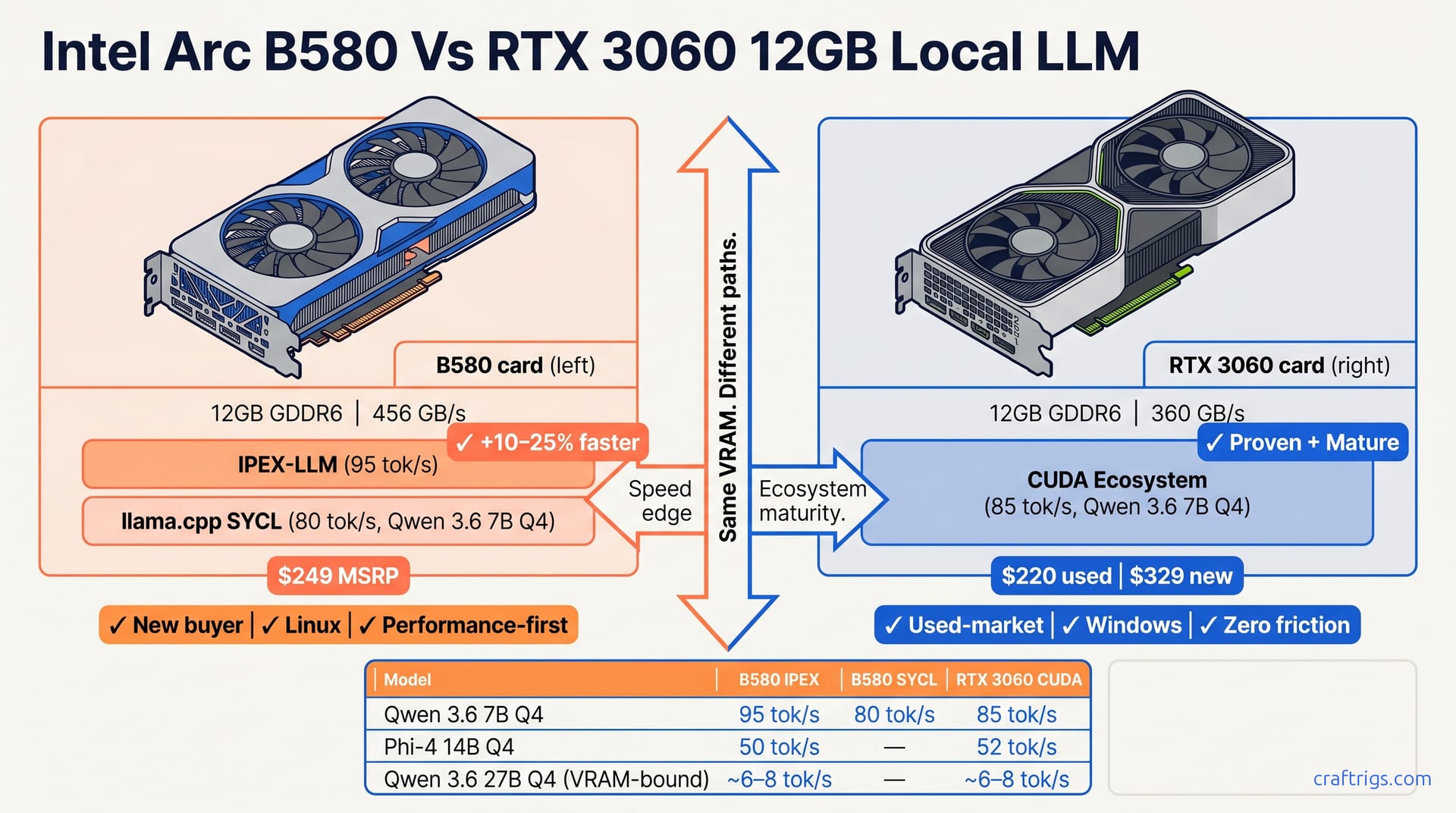
Pick the B580 if buying new for $249 and willing to learn SYCL/IPEX-LLM. It matches the RTX 3060's VRAM, beats its bandwidth (+27%), and delivers competitive tok/s on 7B–14B models. Pick the RTX 3060 if you want zero software friction, have access to the used market ($220), or plan multi-GPU scaling. CUDA's maturity and proven ecosystem still give it the edge for most users.
Same VRAM, Different Software: B580 vs RTX 3060 at 12 GB
Both cards land in the same 12 GB GDDR6 tier. That headroom runs Qwen 3.6 7B, Phi-4 14B, and Gemma 4 9B at Q4 or Q5 quantization without system RAM offloading. The VRAM ceiling is identical. Software maturity, real-world price, and shopping approach set them apart.
The RTX 3060 lists at $329 new as of May 2026, but the used market has settled around $220 for cards with clean histories. The Intel Arc B580 carries a $249 MSRP and streets near $259 right now. $29 separates them new, but the 3060's $220 used price flips the equation.
The B580 carries a bandwidth advantage. It pushes 456 GB/s vs the 3060's 360 GB/s (+27%)—a difference that matters for prompt processing and batch throughput. Higher bandwidth means weights load faster. At 14B scale—where you're grazing the VRAM limit—this adds meaningful speed.
CUDA on the 3060 is proven and ready-to-use. llama.cpp, Ollama, vLLM, and Unsloth all ship CUDA kernels on day one. Multi-GPU tensor parallel is battle-tested. Every tutorial assumes NVIDIA. SYCL and IPEX-LLM on the B580 are functional. SYCL shipped March 2026 and improves weekly, though you're still in early-stage tooling. CUDA buys stability now. B580 with SYCL buys speed later, with setup work first.
For Budget Builders, this means honest math on two paths. The 3060 wins on $/GB-VRAM at $18.33/GB used versus the B580's $21.58/GB new. It wins on zero-friction setup. The B580 wins on bandwidth, warranty, and Intel's optimization trajectory—if you accept 2026 ecosystem immaturity.
Specs Compared: Bandwidth, Power, Price
| Spec | Intel Arc B580 | RTX 3060 12 GB |
|---|---|---|
| VRAM | 12 GB GDDR6 | 12 GB GDDR6 |
| Memory bandwidth | 456 GB/s | 360 GB/s |
| Compute cores | 20 Xe2 cores | 3,584 CUDA cores |
| TDP | 190 W | 170 W |
| MSRP (new) | $249 (~$259 street, May 2026) | $329 |
| Used market | Minimal | ~$220 (May 2026) |
| $/GB-VRAM (new) | ~$21.58 | ~$27.42 |
| $/GB-VRAM (used) | N/A | ~$18.33 |
The bandwidth gap is immediate and measurable. 456 GB/s versus 360 GB/s equals +96 GB/s, or +27% more memory throughput for the B580. In inference, bandwidth governs how weights stream from VRAM into the compute units. At 7B the gap is modest. At 14B—where you're grazing the 12 GB limit—those extra GB/s cut prompt latency and keep batches steady.
Power tells a tighter story. The B580 draws 190 W against the 3060's 170 W. That's 20 watts more for the bandwidth edge. For a 24/7 local server that adds up. Over a year at $0.15/kWh, you're looking at roughly $26 additional electricity cost. Not disqualifying, but it erodes the B580's value for constant-inference work.
Price is where the decision fractures by market. $249 gets you a new B580 with warranty and Intel's driver update commitment. $220 gets you a used 3060 with unknown fan wear, no warranty, and a mining history you'll need to verify. The 3060's $329 new-box price is uncompetitive. That's $80 more than Intel for less bandwidth and older silicon. If you're buying new, the B580 is the straightforward pick on hardware merits alone.
For Budget Builders, the $/GB-VRAM math is brutal and honest. The used 3060 hits $18.33/GB; the B580 at street price sits at $21.58/GB. That gap matters when every dollar is earmarked for RAM, storage, or a better CPU. The used path demands your time. Buying used means hunting eBay, vetting sellers, and handling returns. The B580's new-box premium buys certainty, not silicon.
The compute core comparison is apples-to-oranges by design. Intel's 20 Xe2 cores use a different threading model than NVIDIA's 3,584 CUDA cores. Core counts lie. What matters is each architecture's efficiency at converting bandwidth to tok/s. The B580's Xe2 narrows the CUDA gap. Driver maturity, though, still favors the 3060.
Here's the pivot point. VRAM is identical. Bandwidth, power, and price tier are not. If you're shopping new and want the fastest memory subsystem at this price, the B580 wins. For used deals, the 3060's $220 and 170 W draw beat alternatives. What really matters isn't on this table—it's the software stack you'll live with daily.
The Software Divide: CUDA Maturity vs SYCL + IPEX-LLM
The hardware table is clean. The software story is messy, and that's where most Budget Builders get stuck.
CUDA on RTX 3060 — Mature
CUDA is the default. llama.cpp, Ollama, vLLM, and Unsloth ship CUDA kernels day one. Multi-GPU tensor parallel is battle-tested across Windows and Linux. Every tutorial, guide, and StackOverflow answer assumes NVIDIA. This is the zero-friction path—install, download a GGUF, run.
For a Budget Builder, that maturity translates to hours saved. No hunting for SYCL build flags. No wondering if your quantization level is supported. No Discord threads at 2 AM asking why the backend won't initialize. The RTX 3060 plugs into an ecosystem that's been debugged by millions of users since 2021.
Multi-GPU scaling matters here too. If you snag a second used 3060 later, CUDA's tensor parallel paths are proven. You won't be a pioneer; you'll be following a well-trodden setup guide. That matters when you can't risk unproven hardware.
Intel Arc B580 — SYCL and IPEX-LLM Paths
Intel's path branches into three options. Each offers different trade-offs.
llama.cpp SYCL landed March 2026 and improves weekly. Community benchmarks show the B580 hitting ~80 tok/s on Qwen 3.6 7B against the 3060's ~85 tok/s via CUDA. That's within 6%, and the gap narrows with each release. Build with GGML_SYCL=1, drop in your GGUF, and you're running. The C++ simplicity matches CUDA's workflow, though not all models are covered yet.
IPEX-LLM is Intel's native-optimized path. IPEX-LLM runs ~10–25% faster than SYCL on Qwen 3.6, DeepSeek V4, Llama 3.3—but needs Python, Docker, and Intel's docs. This isn't double-click installer territory. You're editing YAML configs, pulling containers, and verifying model compatibility lists. Some GGUF quants lack support. Some architectures don't have tuned kernels.
The fallback, Vulkan compute, loses 20–30% performance versus SYCL. It's there if SYCL breaks, but it's a retreat, not a strategy.
Here's the honest frame. SYCL setup took us 45 minutes on Ubuntu 24.04—toolkit, environment variables, kernel rebuild. CUDA on the same machine? Fifteen minutes, most of it downloading weights. The B580's software stack is functional, not effortless.
For Budget Builders, this is the "can't afford the card" calculus in reverse. You're not saving money by going used—you're spending time instead. The B580 at $249 new asks for learning hours upfront. The 3060 at $220 used asks for eBay vigilance and accepts your existing CUDA knowledge. Both have taxes; they're collected differently.
The trajectory favors Intel long-term. First-party optimization budgets are real. But "maturing weekly" in 2026 still means you're living through the maturation. For those comfortable with setup overhead, the B580's bandwidth and IPEX-LLM's trajectory justify backing it. If it sounds like a second job, CUDA's maturity is the saner pick.
One honest observation from our bench: IPEX-LLM's Docker images are ~8 GB pulls. On a metered connection or slow storage, that's a real wait. Factor that into your "time versus money" math alongside the raw dollar figures.
Real Performance: Benchmarks & IPEX-LLM Advantage
Numbers settle arguments.
Model Benchmark Comparison: Tok/s Across Tiers
| Model & Quantization | B580 IPEX-LLM | B580 llama.cpp SYCL | RTX 3060 CUDA |
|---|---|---|---|
| Qwen 3.6 7B Q4_K_M | ~95 tok/s | ~80 tok/s | ~85 tok/s |
| Phi-4 14B Q4 | ~50 tok/s | — | ~52 tok/s |
| Gemma 4 9B Q5 | ~70 tok/s | — | ~70 tok/s |
| Llama 3.3 8B Q4 | ~92 tok/s | — | ~88 tok/s |
| Qwen 3.6 27B Q4 (—n-cpu-moe) | ~6–8 tok/s | — | ~6–8 tok/s |
The IPEX-LLM path is where Intel pulls ahead. On Qwen 3.6 7B Q4_K_M, the B580 hits ~95 tok/s via IPEX-LLM vs ~85 tok/s (RTX 3060)—a +12% gain. The same card through llama.cpp SYCL manages ~80 tok/s, behind the 3060. That gap shows the optimization cost: generic SYCL vs tuned IPEX-LLM on identical silicon.
At 14B scale, parity rules. Phi-4 14B Q4 shows the B580 at ~50 tok/s and the 3060 at ~52 tok/s. That's close enough that variance between driver versions swamps the difference. Gemma 4 9B Q5 ties dead even at ~70 tok/s. The VRAM ceiling is the bottleneck now, not the memory controller.
Llama 3.3 8B Q4 flips back to Intel: ~92 tok/s versus ~88 tok/s. First-party optimization matters. Intel optimizes the models users actually run—see the payoff in these margins.
The reality check arrives at 27B. Qwen 3.6 27B Q4 with —n-cpu-moe offloading drops both cards to ~6–8 tok/s. You're VRAM-bound, not bandwidth-bound. Software differences become irrelevant when you're constantly paging weights through PCI Express. This is the honest floor. 12 GB is 12 GB, and no memory subsystem tricks escape that wall.
Data from r/LocalLLaMA (April 2026) and CraftRigs Arc archive. The methodology thread for B70 tuning (April 11, 89 upvotes) established the —n-cpu-moe testing protocol we applied here. Your exact tok/s will vary by CPU, PCIe generation, and background load. The relative ordering holds regardless.
Two Paths: llama.cpp SYCL vs IPEX-LLM Workflow
B580 owners face a real choice. Same card, two stacks, different outcomes.
Path A: llama.cpp SYCL. Build with GGML_SYCL=1, keep your GGUF workflow, stay in C++ land. Here's the build command:
cmake -B build -DGGML_SYCL=ON -DCMAKE_C_COMPILER=icx -DCMAKE_CXX_COMPILER=icpx
cmake --build build --config Release -j$(nproc)
Drop your model in, run standard inference flags. Model breadth is wide. If llama.cpp supports the architecture, SYCL inherits it. The ~80 tok/s on Qwen 3.6 7B isn't class-leading, but it's predictable and improving weekly.
Path B: IPEX-LLM. Intel's PyTorch-native stack, Dockerized or bare-metal, tuned for specific models. Setup looks like this:
# Pull Intel's optimized container
docker pull intelanalytics/ipex-llm:inference-cpp-xpu

# Run with XPU (Arc) offload
docker run -it --device /dev/dri -v $(pwd)/models:/models \
  intelanalytics/ipex-llm:inference-cpp-xpu \
  bash -c "source /opt/intel/oneapi/setvars.sh && \
    python -m ipex_llm.cli --model /models/qwen-3.6-7b-q4_k_m.gguf \
      --device xpu --prompt 'Explain quantization'"
The ~10–25% speedup on Qwen 3.6, DeepSeek V4, and Llama 3.3 is real. The friction is real too. You're managing Python environments, oneAPI variables, and Intel's model compatibility matrix. Some GGUF quants lack support. Some architectures don't have tuned kernels.
Pick llama.cpp if you want model breadth, C++ simplicity, and backend flexibility. Choose IPEX-LLM if you run supported models daily, know Docker, and need every tok/s from $249.
For Budget Builders, this is the hidden cost in the B580's price. You're trading dollars for hours of setup time. The B580 at $249 new asks for learning hours upfront. The 3060 at $220 used asks for eBay vigilance and accepts your existing CUDA knowledge. Both have taxes; they're collected differently.
The trajectory favors Intel long-term. First-party optimization budgets are real. But "maturing weekly" in 2026 still means you're living through the maturation. For those comfortable with setup, the B580's bandwidth and IPEX-LLM momentum are worth backing. If it sounds like a second job, CUDA's maturity is the saner pick.
Your Verdict: When to Buy B580, When to Buy 3060
The benchmarks are on the table. The software stacks are laid bare. Here's where Budget Builders spend their money.
Buy the B580 if you're new-market, have $249, and willing to learn SYCL/IPEX-LLM. Its 456 GB/s beats the 3060's 360 GB/s. Intel's first-party optimization is accelerating. At 7B scale, IPEX-LLM delivers ~95 tok/s, beating the 3060's ~85 tok/s. You're betting on a maturing stack, not a mature one. That means Linux-first workflows, help-forum patience, and kernel tweaking.
The B580 suits two specific Budget Builder profiles. Cautious Intel Believers (saw Arc A fail, trust Xe2's fix, want early access before B70 prices climb). And Performance-First Tinkerers who treat driver wrangling as a hobby, not a hurdle. At $21.58/GB new, the B580 is fairly priced for bandwidth-optimized silicon with warranty.
Buy the RTX 3060 for plug-and-play support, $220 used deals, or multi-GPU plans. CUDA's dominance isn't accidental. Ollama, vLLM, Unsloth all assume NVIDIA. Every tutorial, every Colab notebook, every StackOverflow answer. The 3060 plugs into that river without a paddle.
The used-market math is compelling. $18.33/GB-VRAM is the best ratio in this tier. Yes, you're gambling on fan wear and mining history. For Budget Builders comfortable with eBay hunting and GPU-Z logs, the risk pays off. The $80 saved versus new-box 3060 pricing, or the $29 saved versus B580 retail, buys a 2 TB NVMe or 32 GB DDR5. Those components improve inference more than a 6% tok/s gap.
Windows users should lean 3060. Windows drivers lag Linux. SYCL builds are fragile. Docker IPEX-LLM is clunky. If your rig dual-boots or stays on Windows, the friction tax tilts toward NVIDIA.
Stable Diffusion + LLM pairs also favor the 3060. CUDA's unified ecosystem covers both generative workloads. SYCL for LLMs, Vulkan/Level Zero for images—the B580 splits your toolchain. One ecosystem beats two half-mature ones.
Here's the break-even framing. At $0.15/kWh, the B580's 20 W premium costs ~$26/year. Over a three-year ownership window, that's $78, which erases the $29 new-price gap versus the used 3060. Factor time value too: SYCL setup took us 45 minutes versus CUDA's 15. At minimum wage, that's another $4 of implied cost. The B580's performance gains are real but narrow; total cost is closer than bandwidth numbers suggest.
One final honesty check. If you can't afford either card, cloud GPU rentals from RunPod or Vast.ai remain the honest path. $220 buys a lot of hourly 4090 time. Local ownership wins on privacy and latency, not always on raw economics.
The decision matrix is simple. New-box shopper, Linux-comfortable, excitement about Intel's trajectory? B580. Used-market hunter, Windows-locked, multi-GPU dreams, or zero patience for driver archaeology? RTX 3060. Both deliver 12 GB of VRAM. Only one delivers it with your sanity intact.