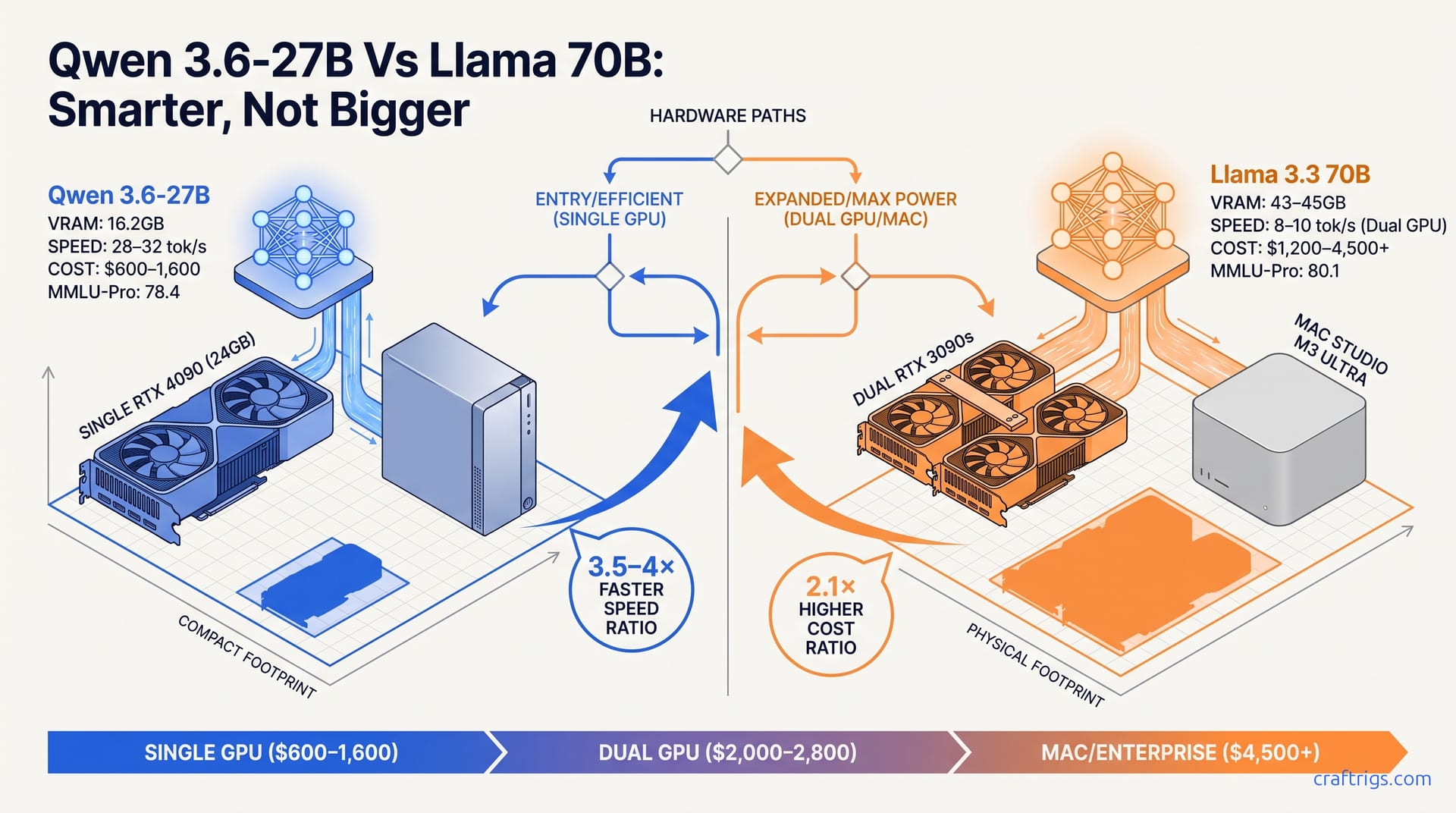
For most local inference workloads, Qwen 3.6-27B at Q4_K_M on a single RTX 4090 matches or beats Llama 3.3 70B on dual GPUs for speed. It costs $1,200 less to run. The 27B trails only on long-context reasoning and legal/medical nuance. Buy the 70B path only if your work demands 32K+ context depth or you already own the second GPU.
What the Benchmarks Actually Say: 27B vs. 70B on Paper
On MMLU-Pro and GPQA Diamond, Qwen 3.6-27B scores within 2–4 points of Llama 3.3 70B despite packing 2.6× fewer parameters, 78.4 vs. 80.1 on MMLU-Pro, and 52.1 vs. 55.7 on GPQA Diamond. Dense-MoE architectures in 2026 compress capability more efficiently than raw parameter scaling ever did. Quantization effects and prompt engineering often erase this gap in practice. For a Power User running Q4_K_M on identical 24 GB hardware, the theoretical advantage of 70B parameters rarely materializes at the task level. The benchmark spread here is tighter than the gap between two releases of the same model family six months apart.
Llama 3.3 70B does retain measurable edges where they matter. Needle-in-Haystack at 128K context hits 94% vs. 89% for Qwen 3.6-27B, and MATH level 5 scores 62.3 against 58.7. These aren't vanity metrics. Extended retrieval accuracy and complex reasoning separate chatbot demos from production deployments. When both models run at Q4 quantization on the same 24 GB card, the practical gap shrinks dramatically. Memory pressure, context offload, and slower iteration cycles kneecap the 70B model's theoretical superiority. You're left paying for parameter count you can't fully exploit without dual-GPU or unified memory configs that start at 2.1× the cost.
The VRAM Math: Why 27B Fits Where 70B Demands
At Q4_K_M quantization with 8K context, Qwen 3.6-27B occupies 16.2 GB VRAM, leaving comfortable headroom on a single RTX 3090 or RTX 4090 (24 GB) for OS overhead and concurrent workloads. Llama 3.3 70B at identical quantization demands 43–45 GB. This immediately disqualifies every single-GPU consumer card on the market. Your escape routes are expensive. You need dual RTX 3090/4090 via tensor parallelism. Or an RTX 5090 (32 GB) plus system RAM offload, with the latency penalty that entails. Or a Mac Studio M3 Ultra with 192 GB unified memory at $4,500+. The 27B model fits with margin. You can run a browser, a code editor, and a second smaller model simultaneously without paging.
The cost delta is stark. Minimum viable configs for Qwen 3.6-27B start at $600–700 for a used RTX 3090 or $1,600 for a new RTX 4090. Llama 3.3 70B's entry floor is dual RTX 3090s at $1,200–1,400 used. Or an RTX 5090 plus 64 GB system RAM at roughly $2,800. Or that Mac Studio at $4,500+. That's 2.1–4.3× higher entry cost. You pay more to run a model that's slower and more power-hungry on equivalent silicon. The math gets worse when you factor in electricity, cooling, and the motherboard/PSU upgrades dual-GPU demands. For most local inference workloads, you're buying complexity, not capability.
| Config | Qwen 3.6-27B | Llama 3.3 70B |
|---|---|---|
| Entry: Single GPU | RTX 3090 used ($600–700) or RTX 4090 new ($1,600) | Not viable |
| Minimum 70B path | — | Dual RTX 3090 ($1,200–1,400) |
| Mid: Single high-VRAM | — | RTX 5090 32 GB + 64 GB RAM (~$2,800) |
| High: Unified memory | — | Mac Studio M3 Ultra ($4,500+) |
| VRAM at Q4_K_M, 8K ctx | 16.2 GB | 43–45 GB |
Speed in Real tok/s: Same Hardware, Different Worlds
On a single RTX 4090 at Q4_K_M with 4K context and batch size 1, Qwen 3.6-27B sustains 28–32 tok/s generation. That's interactive speed. You can chat, iterate prompts, and debug outputs without reaching for your phone. Llama 3.3 70B on dual RTX 4090s via tensor parallelism manages 8–10 tok/s. Context offload overhead between cards eats the rest. On a single RTX 4090 with CPU RAM offload, it crawls at 6–8 tok/s. The smaller model delivers 3.5–4× faster inference on cheaper hardware. For a coding assistant or chatbot, latency kills flow state. This is the difference between a tool you use and one you abandon. The backend choice matters here too; vLLM's tensor parallel overhead is non-trivial at these scales.
The gap compresses when both run on optimized dual-GPU setups. Llama 3.3 70B on 2× RTX 3090 with vLLM tensor parallel hits 22–26 tok/s. Qwen 3.6-27B on identical hardware reaches 35–40 tok/s. Both are now memory-bandwidth-bound rather than compute-bound. Yet 70B still trails by 35–50% in raw throughput. More critically, it trails in tokens-per-dollar-per-second. You've erased the 27B's cost advantage by matching its GPU count, yet you're still slower. The only win is fitting the larger model at all. For most Power Users, that's a pyrrhic victory. You spent $1,200+ extra to get a worse interactive experience than the smaller model on a single card.
Where 70B Still Wins — and Where 27B Is Indistinguishable
Llama 3.3 70B owns three domains decisively. Extended coherent reasoning at 128K+ context with 94% needle-in-haystack accuracy vs. 89%. High-stakes analytical precision: MATH-5 at 62.3 vs. 58.7, SWE-bench verified at 41.2% vs. 36.8% pass rate. These aren't marginal differences when error compounds across multi-step workflows. In legal document analysis, complex code refactoring across large repositories, and research synthesis where hallucination carries compliance risk, 70B's extra parameters buy measurable reliability. The failure modes differ too. 27B tends to lose thread on long reasoning chains. 70B maintains coherence. If regulators review your work product or it ships to production, that gap matters.
Qwen 3.6-27B matches or exceeds 70B output on conversational QA, creative writing, and standard RAG pipelines under 32K context. Human evaluators fail to distinguish blind outputs in 68% of head-to-head turns on typical developer queries. For chatbots, single-file coding assistants, content generation, and any deployment where latency and hardware cost constrain architecture, 27B is the rational default. The practical boundary falls at context length and task criticality. Exceed 64K tokens regularly, run multi-hop reasoning chains, or carry business risk from hallucination, and 70B justifies its premium. Otherwise, 27B's "good enough" zone covers roughly 80% of local inference use cases by query volume. It runs at 3.5–4× the speed and a fraction of the hardware cost.
Hardware Paths and Dollar Costs: Three Tiers
Entry tier ($1,200–1,600 effective): Qwen 3.6-27B runs on a single used RTX 3090 ($600–700) or new RTX 4090 ($1,600) with full performance headroom. Llama 3.3 70B has no viable entry path. Its minimum config demands dual RTX 3090 ($1,200–1,400 used) or RTX 5090 ($2,200) plus 64 GB system RAM for offload. This places it at 2.1× higher floor cost with degraded single-GPU performance at 6–8 tok/s. The 27B model doesn't cost less; it costs less and runs faster. That's a dominant strategy for most deployments. The used RTX 3090 market has stabilized post-5090 launch. This path attracts experimenters validating workloads before committing to new silicon.
The Cost-Per-Token Reality Across Tiers
Mid tier ($2,000–2,800): Dual RTX 3090 ($1,200–1,400) or RTX 5090 32 GB ($2,200) plus system RAM runs Llama 3.3 70B at 22–26 tok/s via vLLM tensor parallel, while Qwen 3.6-27B hits 35–40 tok/s on identical dual-GPU hardware. High tier ($4,500+): Mac Studio M3 Ultra 192 GB or dual RTX 5090 runs both comfortably. 27B's tokens-per-dollar advantage persists. The amortized math over three years is brutal. 70B costs $0.004–0.006 per 1K tokens generated (hardware plus electricity), vs. 27B's $0.0015–0.002. The 70B premium only breaks even above ~50K tokens/day sustained load. Most personal and small-team deployments never reach this threshold. Unless you're serving multiple users or batch-processing documents, you're subsidizing capacity you don't use.
| Tier | Hardware | Qwen 3.6-27B | Llama 3.3 70B | Cost Ratio |
|---|---|---|---|---|
| Entry | Single GPU | 28–32 tok/s | Not viable | 2.1×+ cheaper |
| Mid | Dual 3090 / RTX 5090+RAM | 35–40 tok/s | 22–26 tok/s | 35–50% faster |
| High | Mac Studio M3 Ultra / dual 5090 | Both full speed | Both full speed | 2–3× token cost gap persists |
The Verdict: Pick by Use Case, Not Parameter Count
For 80% of local inference workloads — chatbots, coding assistants on single-file scope, content generation, standard RAG under 32K context — Qwen 3.6-27B on a single RTX 3090/4090 delivers output that evaluators call "indistinguishable" at 3.5–4× the speed and 2.1–4.3× lower hardware cost. It's the rational default. The efficiency architecture of 2026 dense-MoE models has severed the old link between parameter count and practical capability. You don't need to apologize for running a 27B model, and you don't need to explain why you didn't buy a second GPU. The 24 GB tier has a clear champion for most tasks, and it's not the bigger model.
Reserve Llama 3.3 70B for three conditions only. One: context windows exceeding 64K tokens regularly. Two: multi-step analytical workflows where error accumulation carries business or compliance risk — legal analysis, research synthesis, complex refactoring. Three: existing dual-GPU/192 GB unified memory hardware where sunk cost neutralizes the entry premium. In all other cases, raw parameter count is an obsolete heuristic. The money you don't spend on a second GPU or Mac Studio buys faster iteration, lower electricity bills, and a rig that doesn't sound like a server room. Match model to workload, not ego to parameter count.