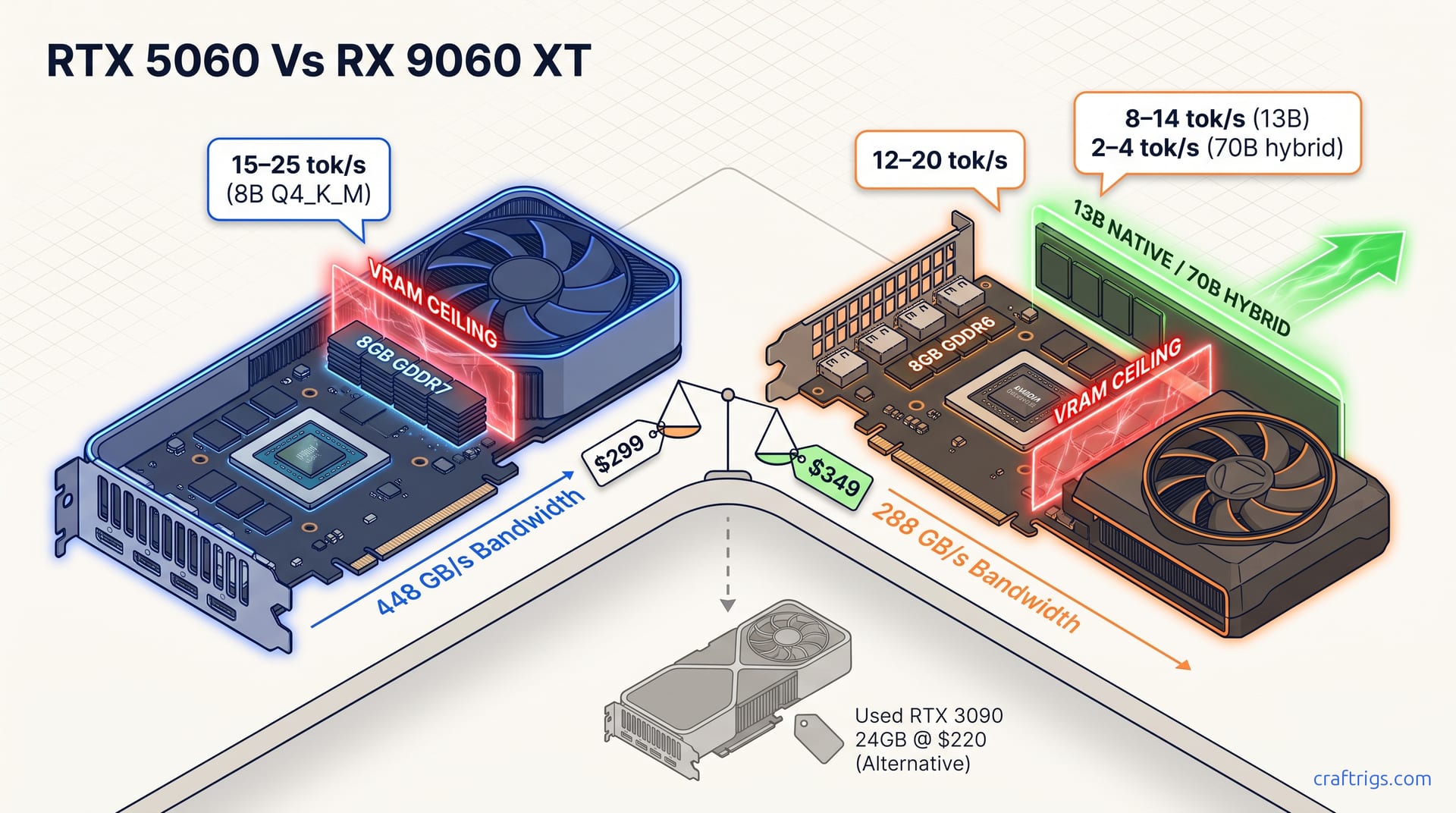
Buy the RX 9060 XT 16 GB for local LLMs at $349. The extra VRAM unlocks 13B Q4_K_M models the RTX 5060's 8 GB cannot fit. The RTX 5060 wins on CUDA speed and plug-and-play setup. Its VRAM ceiling is a hard wall for local AI. Budget builders who must spend $299 should consider a used RTX 3090 instead.
What Actually Launched: RTX 5060 and RX 9060 XT Specs
NVIDIA's RTX 5060 hit shelves on May 19, 2026, at a $299 MSRP with a single configuration: 8 GB of GDDR7. No 16 GB variant, no cut-down 6 GB option for the desktop, just 8 GB across both desktop and laptop SKUs. The memory runs on a 128-bit bus pushing roughly 448 GB/s of bandwidth. That sounds competitive until you realize the capacity ceiling is immutable. For local LLM inference, 8 GB of VRAM is the critical constraint. Capacity caps you regardless of how fast GDDR7 clocks. NVIDIA positioned this card at 1080p-high and 1440p-medium gaming. "Entry-level AI" was a secondary bullet point in press materials. The 8 GB limit isn't accidental, it's segmentation. NVIDIA wants buyers who need more VRAM to step up to the RTX 5060 Ti at $379 or beyond. For budget builders, that $80 jump is meaningful, and the 5060 Ti's own 8 GB base model doesn't solve the problem anyway.
AMD's RX 9060 XT arrives June 5, 2026, with a dual-SKU strategy that's more honest about the local AI use case. The base 8 GB model matches NVIDIA's $299 price point with GDDR6 at ~288 GB/s. Slower memory, same capacity trap. But the 16 GB variant at $349 is the story. That $50 premium buys double the VRAM. In local LLM terms, that's the difference between running 7B models comfortably and fitting 13B models natively. AMD's GDDR6 is older tech than NVIDIA's GDDR7. Yet the capacity advantage overwhelms the bandwidth deficit for inference workloads. Both cards target the same gaming resolution tier. AMD's explicit 16 GB option signals they understand where the local AI market lives. The RX 9060 XT 16 GB isn't a gaming SKU with extra memory bolted on. It's the cheapest new 16 GB entry point for local LLMs in the entire 2026 generation. It undercuts even last-gen holdovers like the RX 7600 XT 16 GB at $329 (soon EOL).
The $299 Tier Fight: Where NVIDIA and AMD Place These Cards
The $299 price point is deliberate positioning against a specific competitive set, and understanding that set explains why both vendors are willing to sell 8 GB cards they know are constrained. The RTX 5060 undercuts the RTX 5060 Ti at $379 by $80, while the RX 9060 XT 8 GB sits $150 below the RX 9070 GRE at $449. These gaps aren't random, they're designed to capture buyers who cannot stretch their budget, even when stretching would solve their problem. NVIDIA and AMD both know that 8 GB is insufficient for serious local AI. They're counting on those buyers either not knowing better, or accepting the limitation as a temporary stopgap. The tragedy is that the used market already offers better solutions at similar prices. Both vendors hope you'll ignore this in favor of warranty certainty and that new-card smell.
Last-gen displacement tells the real story. The RTX 4060, now $229 used, becomes irrelevant for local AI buyers. Its 8 GB is the same trap, cheaper and slower. The RX 7600 XT 16 GB at $329 was the previous budget champion for local LLMs, but its EOL status means inventory is drying up; AMD is replacing it with the 9060 XT 16 GB at $349, a $20 generational price hike that preserves their monopoly on sub-$400 new 16 GB cards. For the budget builder segment, the math is brutal: at $299, both new 8 GB cards lock you to 7B models. The $50 jump to 16 GB isn't a luxury, it's the minimum viable spec for 13B inference. NVIDIA doesn't offer that jump at any 50-series price; AMD does. The "tier fight" framing misses the point. It isn't NVIDIA versus AMD at $299. It's 8 GB versus 16 GB across the entire $299–$349 range, with only one vendor playing both sides.
What 8 GB vs 16 GB VRAM Means for Local LLMs
VRAM capacity is the hard constraint for local LLM inference, and the 8 GB versus 16 GB divide isn't gradual, it's a cliff. At 8 GB, both the RTX 5060 and RX 9060 XT base model fit 7B-parameter models at Q4_K_M quantization (~4.3 GB file size). They leave comfortable headroom for context windows and system overhead. You can run Llama 3.1 8B, Mistral 7B, or similar models without heroic measures. But 13B models at Q4_K_M (~8.1 GB) immediately trigger out-of-memory errors. They require aggressive context-window trimming to even load. The workaround, Q5_K_M quantization or CPU offload, degrades quality or speed. That defeats the purpose of local inference. This isn't a "maybe it'll work" scenario; it's deterministic. Ollama and llama.cpp allocate VRAM at load based on model weights plus KV cache for context. Eight gigabytes minus overhead leaves no margin for 13B parameters at standard quantization. Budget builders who don't understand this constraint buy the wrong card, discover the limitation weeks later, and face a resale or return hassle.
The 16 GB RX 9060 XT variant changes the entire equation for a $50 premium. Thirteen-billion-parameter models at Q4_K_M load natively with headroom for 2,000+ token context windows. That's enough for substantial document analysis or multi-turn conversations. More dramatically, 70B models at Q4_K_S become tentatively viable via CPU/GPU hybrid offload. The GPU handles what fits in 16 GB. The CPU manages the remainder. At 2–4 tok/s, this isn't interactive chat. It's batch inference or "will it answer my question eventually" territory. But it runs, which is more than any 8 GB card can claim. The $50 premium is the cheapest 16 GB entry point in the 2026 generation. No other new card at $349 offers this capacity. For budget builders doing break-even math, that's roughly $3.12 per GB of VRAM versus $37.38 per GB for the 8 GB cards. That's a 12× efficiency gap. It dwarfs any bandwidth or architecture advantage NVIDIA holds.
The 8 GB Reality: 7B Models Work, 13B Needs Compromises
The 8 GB ceiling is mathematically unforgiving. A 7B model at Q4_K_M occupies ~4.3 GB on disk but expands with KV cache allocation during inference. At 2K context, you're looking at ~5.5–6 GB actual VRAM usage. That leaves 2 GB for system overhead, which is tight but functional. Step to 13B Q4_K_M at ~8.1 GB and you've already exceeded capacity before context allocation. The compromises, Q5_K_M (smaller file, lower quality), trimmed context (shorter conversations), or CPU offload (slower speed), all extract penalties. They make the "budget" card feel expensive in frustration. Budget builders should note: the $299 price is a trap if your use case includes any model larger than 7B parameters. The card works, but for a narrower set of tasks than marketing implies.
The 16 GB Unlock: 13B Native, 70B With CPU Help
Sixteen gigabytes is the minimum threshold for 13B-native inference without quality compromises. The RX 9060 XT 16 GB loads Llama 3.1 13B Q4_K_M at ~8.1 GB with room for 4K+ context. This enables actual document summarization and coherent multi-turn dialogue. The 70B Q4_K_S hybrid offload is the stretch goal. ~40 GB of weights split between 16 GB GPU and system RAM, with the CPU handling the majority. Setup requires explicit layer allocation in llama.cpp or Ollama's --num-gpu-layers flag, and speeds at 2–4 tok/s demand patience. But the model runs, answers questions, and demonstrates capabilities no 8 GB card can approach. For budget builders, this is the "future-proofing" that matters. Not ray-tracing cores or AI upscaling, but the ability to load larger models as they release.
Local LLM Performance: What to Expect at This Tier
Speed expectations at this price tier need calibration against reality, not marketing. The RTX 5060's GDDR7 at ~448 GB/s delivers 15–25 tok/s for Llama 3.1 8B Q4_K_M. It leverages CUDA-optimized llama.cpp builds and NVIDIA's mature tooling. That's responsive for interactive chat, coding assistance, and light summarization. The RX 9060 XT 8 GB with GDDR6 at ~288 GB/s manages 12–20 tok/s for the same model, slower, but not brokenly so. The gap is real: roughly 20–25% in NVIDIA's favor for pure token generation. Bandwidth and CUDA kernel optimization drive it. For budget builders who prioritize "it works" over absolute speed, this difference matters less than the capacity ceiling. Both 8 GB cards feel similar in practice because they're both trapped at 7B models. The RTX 5060's speed advantage is academic when you can't load the model you want to run.
The 16 GB RX 9060 XT matches its 8 GB sibling's inference speed. Same GPU, same memory bandwidth. It adds capacity for larger models at proportionally lower speeds. Thirteen-billion-parameter Q4_K_M runs at 8–14 tok/s, still interactive for most use cases. Seventy-billion-parameter Q4_K_S via CPU/GPU hybrid drops to 2–4 tok/s. That's comparable to reading speed rather than conversational flow. These are entry-level speeds, roughly 3–5× slower than an RTX 4090's throughput. They're comparable to Apple M4 Pro running via MLX. The comparison isn't flattering, but it's honest: this tier is viable for experimentation, learning, and light productivity, not for batch processing or real-time applications. Budget builders should calibrate expectations accordingly. If you're comparing against cloud API costs, even 2–4 tok/s can pencil out favorably over months of use. That's a patience trade-off, not a performance win.
The Verdict: Which to Buy for Local AI
For pure local AI at $299–$349, the RX 9060 XT 16 GB at $349 is the only rational choice. The 8 GB cards, both RTX 5060 and RX 9060 XT base, lock you to 7B models regardless of speed or tooling advantages. Sixteen gigabytes unlocks 13B native and 70B hybrid. These capabilities expand what local LLMs can do for your workflow. The $50 premium is cheaper than any other 16 GB entry point in the 2026 stack. No competitor offers new 16 GB VRAM below $349. This isn't preference or brand loyalty, it's a capacity floor that 8 GB cannot meet. Budget builders doing honest break-even math should treat the $299 8 GB cards as gaming-first SKUs with AI as a side feature. They're not AI cards that happen to play games.
Buy the RTX 5060 only if your use case requires CUDA-only tooling like TensorRT-LLM or vLLM. Or if DLSS 4 gaming is your primary goal with local AI as occasional experimentation. Even then, the 8 GB ceiling remains. Avoid the 8 GB RX 9060 XT. It loses to the RTX 5060 on speed and tooling without beating it on price. It loses to its own 16 GB variant on the only spec that matters for local AI. The worst buy in this generation is that 8 GB AMD card. It's stranded between better alternatives on both sides. For budget builders who've already internalized the VRAM hierarchy from our hardware pillar, this verdict won't surprise; for newcomers, it's the difference between a useful rig and a regret purchase.
When Neither Card Makes Sense: Used and Stretch Alternatives
The new-card market at $299–$349 faces brutal competition from used alternatives that make both vendors' offerings look cautious. A $220 used RTX 3090 24 GB outclasses either new card on VRAM for local LLMs. It runs 70B Q4_K_M natively at 8–12 tok/s. That's faster than the 9060 XT 16 GB's hybrid offload, with triple the capacity. The caveats are real: the 3090 runs hot, draws 350 W, and carries no warranty. Budget builders comfortable with blower-style noise and repasting can access a tier of performance no new card under $600 matches. The break-even math is compelling. $220 for 24 GB versus $349 for 16 GB, if you'll accept the used market's risk profile. For pure local AI, this is the hidden champion that marketing departments hope you'll forget exists.
At $380 new, the RX 7800 XT 16 GB matches the 9060 XT's capacity with proven ROCm stability and a mature driver stack. It's the conservative alternative for buyers who want warranty, lower thermals, and established community support. Stretching past $400 only makes sense if warranty certainty is non-negotiable. The next meaningful tier jump is the RTX 4070 Ti SUPER 16 GB at $599 used. It adds tensor core throughput and better CUDA optimization without more VRAM. For budget builders, the decision tree is simple: maximum VRAM per dollar means used 3090, warranty-plus-16 GB means new 7800 XT or 9060 XT 16 GB, and new-card-only with future-proofing means stretching to $599 or beyond. The $299–$349 new cards aren't bad; they're not the best value for local AI. Sometimes the right buy isn't the newest launch. It's the card that runs the model you want, at the price you can afford, with trade-offs you can live with.