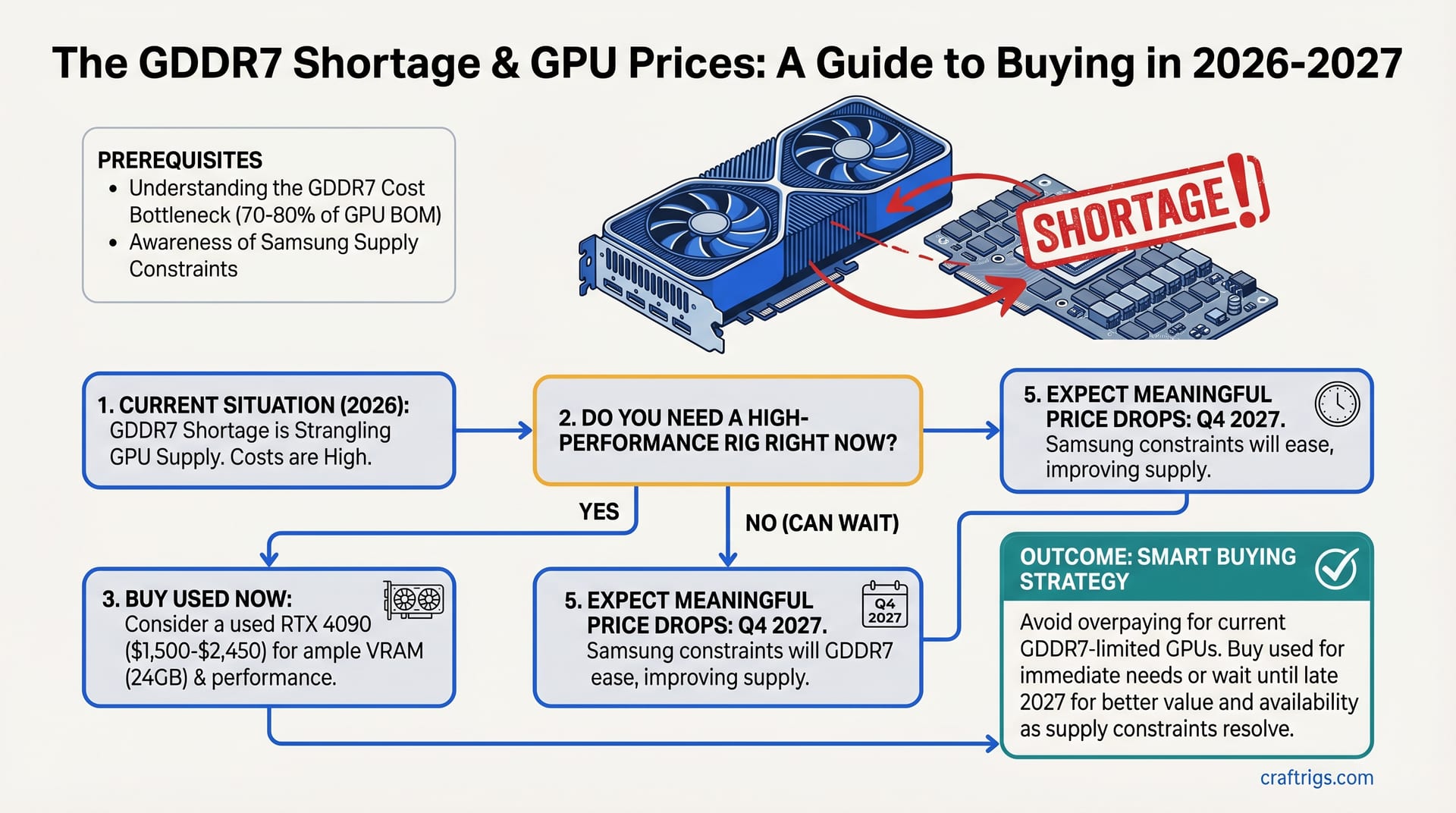
TL;DR: GDDR7 memory has become the cost bottleneck in GPU manufacturing—it's 70-80% of the bill of materials now. Samsung's supply constraints mean consumer GPU prices won't drop meaningfully until Q4 2027, not late 2026. If you need a rig now, buy used RTX 4090 ($1,500-$2,450). If you can wait six months, hold cash and buy RTX 5080 or 5090 in October 2026 when allocation stabilizes. If your budget is under $1,500, skip discrete GPUs entirely and build a Ryzen 9 7950X3D with DDR5.
What Is GDDR7 and Why Does It Cost More Than The GPU Die?
GDDR7 is Samsung's latest high-bandwidth VRAM standard, capable of 864 GB/second throughput versus GDDR6X's 576 GB/sec. That's a 50% bandwidth jump, which sounds great—until you realize it made VRAM the most expensive part of the entire GPU.
In 2020, a GPU's cost split like this: silicon die (40%), VRAM (25%), PCB and packaging (35%). Today? Die (15%), VRAM (70-80%), everything else (15-20%). VRAM stopped being a component and became THE component.
A single RTX 5090 uses 32GB of GDDR7. At current spot prices, that VRAM costs roughly $200-$250 to manufacture. The entire GPU die costs less.
This is why NVIDIA's RTX 5090 launched at $1,999 MSRP but ships at $3,200-$6,000 on the street. It's not markup. It's that Samsung can't make enough GDDR7 to fill orders, so everyone who wants one fights over the scraps. Basic supply and demand.
Why GDDR7 Is So Hard to Make
GDDR7 runs at 21 Gigabits per second. That's twice the speed of standard DRAM, which means the memory cells have to be engineered for extreme clock speeds. The slightest defect—a single misaligned transistor—ruins the whole die.
Yields are brutal. Samsung reports 45-50% of wafers pass GDDR7 testing. Compare that to standard DDR5, which clears 75%+ of wafers. You need 30% more raw silicon to produce the same amount of usable GDDR7.
Samsung has two primary DRAM factories: one in South Korea (at absolute capacity), one in China (export-restricted by Seoul for national security reasons). Neither can expand quickly. Building a new fab takes 3-4 years and costs $5-10 billion. SK Hynix and Micron are expanding, but qualification cycles for NVIDIA/AMD take 12-18 months. Relief isn't coming from new suppliers before Q2 2027 at the absolute earliest.
Warning
GDDR7 supply won't catch up to demand until memory builders finish ramping new fabs. That's 18+ months away. Prices aren't dropping this year.
The Supply Chain Crisis: Why AI Is Stealing Your GPU VRAM
Here's what broke the market: AI datacenters are hoovering up 20% of global DRAM wafer capacity in 2026. Not 10%. Not 15%. Twenty percent of every DRAM chip made on Earth is going to HBM (high-bandwidth memory) for AI accelerators—GPUs for LLMs, TPUs, and inference clusters.
That sounds abstract until you do the math. Global DRAM production in 2026 is roughly 500 exabytes. AI is consuming 100 exabytes. The remaining 400 exabytes has to feed gaming GPUs, servers, consumer PCs, phones, cars, everything else.
NVIDIA's data center division has explicit priority on GDDR7 allocation from Samsung. When Samsung produces 50 petabytes of GDDR7 in a month, NVIDIA's datacenter team takes 35 petabytes. AMD gets 10. Consumers get what's left—about 5 petabytes, spread across the entire planet.
This is why NVIDIA cut RTX 50-series production by 30-40% in the first half of 2026. They're not cutting because of yield failures. They're cutting because there's literally no GDDR7 to install.
The Domino Effect on RTX 50 Pricing
RTX 5070 Ti (16GB GDDR7):
- MSRP: $749
- Street price as of April 2026: $1,000-$1,300
- Why: Limited allocation means scalpers and resellers control inventory
RTX 5080 (20GB GDDR7):
- MSRP: $999
- Street price (April 2026): $1,600-$2,100
- Why: Even scarcer allocation than the 5070 Ti
RTX 5090 (32GB GDDR7):
- MSRP: $1,999
- Street price (April 2026): $3,200-$6,000 (yes, really)
- Why: Only ~50 units per major retailer per month in North America
AMD's RX 9000 series faces identical constraints. AMD doesn't get preferential GDDR7 allocation. Neither does anyone else.
When Will GDDR7 Supply Actually Stabilize?
Gartner projects that memory shortages—including GDDR7—will persist through at least Q4 2027. That's not a typo. Late 2027, not late 2026.
Let's break the timeline down:
Q2 2026 (now): Samsung's South Korea fab is at 95%+ capacity. Allocation to consumer products is minimal. RTX 5090 stock at major retailers: 1-2 units per week.
Q3 2026: Samsung's second production line ramps to volume. GDDR7 supply doubles, but demand still outstrips supply by 2:1. RTX 5080 becomes available more regularly. RTX 5090 remains scarce.
Q4 2026: SK Hynix begins shipping GDDR7 samples to NVIDIA/AMD for qualification. Samsung's expanded line reaches baseline output. Supply/demand ratio improves to roughly 1:1. This is the inflection point where you can actually BUY an RTX 5080 without paying a 60% premium.
Q1 2027: SK Hynix GDDR7 enters mass production. Micron's GDDR7 plans still in qualification. Supply tightens toward equilibrium.
Q2-Q4 2027: Multiple suppliers online. GDDR7 prices drop from $220-$280 per module to $100-$150. RTX 5090 street price falls from $4,000+ to $2,400-$2,600 (still above MSRP). RTX 5070 Ti normalizes to $799-$899.
Note
The Q4 2026 inflection point is when supply meets demand—not when prices drop. Expect $100-$300 premiums over MSRP to persist through Q1 2027.
What You Should Do Right Now: Action Plan by Budget
Your decision tree depends on three things: your budget, your timeline, and how badly you need local LLM capability.
If You Need a Rig RIGHT NOW (Budget: <$1,000)
Buy a used RTX 4090.
Used RTX 4090s (24GB GDDR6X) are trading at $1,500-$2,450 on eBay as of April 2026. That's a lot of money, but here's why it's the right move:
- A 24GB RTX 4090 runs Llama 3.1 70B at 8-12 tokens/second with Q4 quantization
- Outperforms an RTX 5070 Ti (16GB) on quantized models because GDDR6X bandwidth is nearly identical to GDDR7, and 24GB beats 16GB
- No wait—it's available now
- If it fails, eBay Buyer Protection covers you
The risk: you're buying used hardware with unknown history. Check seller ratings ruthlessly. Buy from power sellers with 95%+ feedback. Test the card in a rig for 24-48 hours before committing to long-term use.
Tip
Check Level1Techs forums for used GPU reseller reputation threads before buying. The community maintains a blacklist of scammy sellers.
If You Can Wait 6 Months (Budget: $2,000-$3,000)
Hold cash. Commit to RTX 5080 in September 2026.
Here's why October 2026 is the moment to buy:
- GDDR7 allocation stabilizes enough that RTX 5080 is regularly in stock
- Street prices drop from $1,600+ down to $1,100-$1,300 (still premium, but reasonable)
- No more lottery systems or bot-driven scarcity
Set a calendar reminder for September 1, 2026. When RTX 5080 availability improves (check your favorite retailers daily starting Sept 1), commit immediately. These cards won't stay in stock long, but they'll be findable, which is more than you can say today.
If Your Budget Is $1,000-$1,500 (Skip GPU Shortage Entirely)
Build a Ryzen 9 7950X3D rig with DDR5 and a used RTX 4060 discrete GPU.
The build:
- Ryzen 9 7950X3D: $700
- 32GB DDR5 6000MHz: $150-$200
- RTX 4060 8GB used: $180-$250
- Motherboard (B850): $200-$250
- PSU, storage, case: $300
- Total: ~$1,650-$1,900
The trade-offs:
- CPU inference (Llama 3.1 14B) runs at 4-6 tokens/sec
- GPU-accelerated inference (with RTX 4060 assist) hits 12-14 tokens/sec on 14B models
- You can upgrade the discrete GPU later when prices normalize
- No GDDR7 exposure—DDR5 supply is plentiful
This rig is VRAM-agnostic. You're not fighting Samsung for GDDR7. You're not paying $2,000+ for a GPU. You're getting a flexible, upgradable system that handles local LLMs today and can scale in 2027.
If You're a Power User (Budget: $4,000+)
Timing a multi-GPU setup is brutal right now.
Do not buy RTX 5080 or 5090 today. You will pay peak shortage pricing on both cards. A dual-RTX-5080 setup would cost $3,200-$4,200 right now—completely inflated.
Instead: wait until October 2026 and commit to a dual-RTX-5080 build ($2,200-$2,800 at stabilized October pricing). Or wait until January 2027 when SK Hynix GDDR7 production is online and prices have dropped further ($1,900-$2,400 per RTX 5080).
If you absolutely need 70B+ model inference at high throughput right now, buy two used RTX 4090s ($3,000-$5,000 total, depending on condition) and accept that you're not getting full GDDR7 performance.
How to Monitor GDDR7 Supply in Real Time
Don't just guess when allocation stabilizes. Track these three sources:
1. Samsung Investor Relations (Quarterly Earnings) Samsung reports DRAM production capacity and GDDR7 guidance every quarter. When you see "GDDR7 production up 25% YoY," that's your signal that allocation is improving. Earnings calls happen in late April, July, October, January.
2. r/LocalLLaMA Weekly GPU Price Tracking Thread The subreddit maintains a weekly megathread with real street prices from major retailers. This is ground truth—not MSRP, not theory, actual prices people are paying. Check it every Friday.
3. NVIDIA/AMD Official Product Pages When a GPU changes from "Out of Stock" to "In Stock at [retailer]" on NVIDIA's official page, watch it closely. If it stays in stock for 48+ hours, allocation has stabilized. If it vanishes in 2 hours, shortage is still critical.
The Bottom Line: Q4 2027 Relief, Not Q4 2026
GDDR7 is the new silicon. It's rarer than the GPU die itself, more expensive to produce, and currently allocated 80% to AI datacenters. Consumer GPU supply is what's left.
Expect prices to stay elevated through 2026. Expect allocation to improve starting Q4 2026 (October is the inflection point, not the floor). Expect real price relief—where RTX 5090 drops to $2,500-$2,600—to arrive in mid-to-late 2027.
If you need local LLM capability now: buy used RTX 4090 or build a Ryzen rig. Don't overpay for a shortage-premium RTX 5090.
If you can wait: set a calendar reminder for September 2026 and commit to RTX 5080 when allocation stabilizes.
If you're planning 2027 hardware: wait. The shortage will be over. Prices will be sane. You'll save $500-$1,500 per GPU.
The GDDR7 shortage is structural, not temporary. But it has an end date: late 2027. Plan accordingly.
FAQ
How much faster is GDDR7 than GDDR6X? GDDR7 delivers 864 GB/sec bandwidth versus GDDR6X at 576 GB/sec—a 50% increase. In practice, for local LLM inference, the difference is 10-15% better token throughput on 70B models. Worth the premium eventually, not worth the shortage premium today.
Will SK Hynix or Micron GDDR7 be cheaper than Samsung's? Unlikely in 2027. All three suppliers are hitting capacity limits. Once SK Hynix and Micron bring GDDR7 online, they'll price it within 5-10% of Samsung's rates. Volume will increase, prices will fall, but don't expect a race-to-the-bottom.
Can I use GDDR6 or GDDR6X in newer GPUs instead? No. RTX 50-series is engineered for GDDR7's speed and architecture. You cannot retrofit GDDR6 into an RTX 5090—the memory controller won't recognize it, and the GPU won't POST. The architectural choice is locked in at design time.
Is buying a used RTX 4090 actually safer than a new RTX 5070 Ti? Yes. A used RTX 4090 has proven durability—the Ada architecture has been in the field for 2+ years. An RTX 5070 Ti with GDDR7 is new silicon with an unproven shortage-driven supply chain. Buy used if you need proven reliability.
When should I check back on this article for updates? Check back in September 2026 when RTX 5080 allocation improves. If I haven't updated this post by then, assume the timeline slipped and GDDR7 relief pushed to Q1 2027. Gartner's projections shift quarterly.