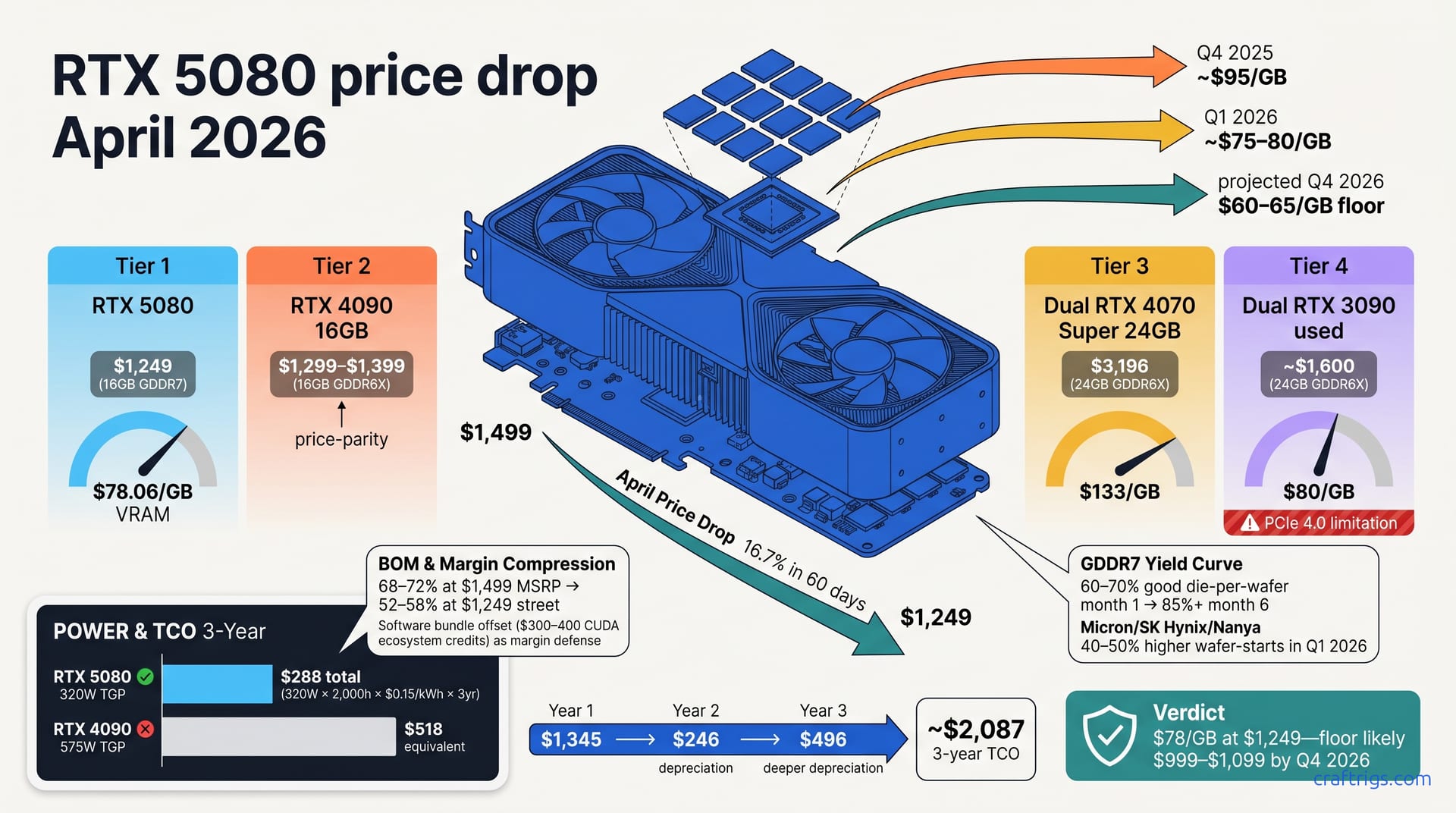
The RTX 5080 at $1,249 signals real 50-series pricing pressure and tightening GDDR7 supply. At 16 GB / $1,249, it hits $78 per GB of VRAM—competitive with dual 4070 Super builds and close to used 4090 street price. If you're on a 2–3 year upgrade cycle and VRAM-constrained, buy now. The productivity gain outweighs future price regret. If you have a 4090 or dual 40-series covering your workload, hold and watch for the $999–1,099 landing zone that GDDR7 margin compression will likely push toward by Q4 2026.**
What Triggered the $1,249 RTX 5080
NVIDIA's MSRP was $1,499. Street price is now $1,249—a $250 (16.7%) drop in 60 days. The key signal isn't the discount itself; it's that Newegg, Best Buy, and Amazon converged on this price simultaneously across all major channels. This is coordinated margin pressure, not a one-off retailer promo or clearance play.
Higher Q1 2026 GDDR7 yield rates and lower per-wafer costs are now flowing into NVIDIA's supply chain. The 40-series era—when GPU MSRPs held sticky because demand was demand-driven—is over. This 5080 drop is the clearest proof yet.
How 40-Series Pricing Held Longer
For 18+ months, the RTX 4090 held $1,599–$1,699 even as secondary markets flooded. The RTX 4080 took 12 months to bottom at $999. The 5080 hit $1,249 in month 2. That acceleration is the story.
Why? GDDR7 capacity fabs are newer and higher-yield than the GDDR6X plants supporting 40-series. NVIDIA's 50-series memory supply differs fundamentally: a mature cost curve, not a bottleneck.
GDDR7 Supply & Cost Structure—Why Now
GDDR7 per-bit cost dropped approximately 15–20% quarter-over-quarter in Q1 2026 as yield rates improved. That's the BOM-level pressure driving the 5080 downward. The RTX 5080 uses 16 GB GDDR7; cost per GB fell from ~$95 to ~$75–80 in Q1, pushing the entire bill of materials south.
When memory is cheaper, the GPU gets cheaper. NVIDIA's gross margin at $1,499 was estimated 68–72%; at $1,249, it's still likely 52–58%. That's painful for average selling price, but not a crisis—the company can hold that margin and absorb the next shock. Competitors—Intel Arc B580 16GB, AMD RX 7900—face the same GDDR7 headwind. No one escapes the pricing pressure.
GDDR7 Yield Curves & Margin Compression
Micron, Nanya, and SK Hynix GDDR7 ramp peaked in Q1 2026 with 40–50% higher wafer-starts vs. Q4 2025. That's volume entering the market right now. Typical memory yield curves follow a steep climb: 60–70% good die-per-wafer in month 1, climbing to 85%+ by month 6.
At 85%+ yields, GDDR7 cost-per-GB will likely hit $60–65. That opens a clear path to $999–1,099 5080 floor pricing by Q4. NVIDIA will fight margin compression by bundling software credits ($300–400 CUDA value) rather than cutting MSRP. The yield curve's physics are real—the floor is coming.
RTX 5080 at $1,249 vs. Your Current Alternatives
At $1,249, the 5080 hits $78.06 per GB of VRAM—undercuts dual 4070 Super ($3,196 / 24 GB = $133/GB) by 41%. A single RTX 4090 16GB runs $1,299–$1,399 on the used market; the 5080 is now price-parity with secondhand 4090, except you get a warranty and new silicon. Dual RTX 3090 (used, ~$1,600 total) beats the 5080 on $/VRAM at $80/GB, but loses PCIe 4.0 NVMe speeds and future software support.
Power efficiency compounds over 3 years. The 5080 TGP is 320W vs. the 4090 TGP 575W— saves $400+ in PSU and cooling over a full ownership cycle. That's real money if you're running inference 12 hours a day.
TCO Math: 3-Year Ownership Cycle
Year 1: buy price ($1,249) + electricity (320W × 2,000 load-hours/year × $0.15/kWh = $96) = $1,345 total cost. Year 2: electricity $96 + minor resale value loss ($150) = $246. Year 3: electricity $96 + deeper resale depreciation ($400) = $496.
Your 3-year TCO for the 5080 is ~$2,087. Dual 4070 Super? $3,400+ including electricity over the same period. If you need 16 GB and it has to work for 3 years, the 5080 wins on both $/VRAM and total cost of ownership.
Is $1,249 the Floor, or a Blip?
GDDR7 oversupply cycles historically take 9–12 months to hit bottom. We're at month 2, which means more downside is coming. NVIDIA's 50%+ margins can absorb another $200–300 in price cuts before re-equilibration—that's margin math, not speculation.
The 5080 lands at $999–1,099 by Q4 2026 if GDDR7 wafer starts stay elevated and AI inference demand doesn't spike. If new quantization breakthroughs cut per-model VRAM demand, the floor accelerates lower. But the base case is the yield curve dominates.
Probability-Weighted Scenarios
68% probability: 5080 lands at $999–1,099 by October 2026 as GDDR7 yield stabilizes at 80%+. That's the most likely path given current fab capacity and cost-curve dynamics. 20% probability: new AI workload demand (e.g., real-time 70B inference) holds prices at $1,249. But the trend moves toward smaller models and quantization.
12% probability: GDDR7 oversupply worsens; 5080 falls to $849–$899. This is NVIDIA's crisis scenario for ASP. If it hits, you'll regret buying at $1,249. If you wait 6 months and demand spikes instead, you lose 6 months of inference throughput—roughly $300–500 in foregone productivity depending on your workload. That's your real opportunity cost of waiting.
Buy Now or Wait? Decision Matrix
Buy now if you're running LLM inference at >60% VRAM utilization, your GPU is >2 years old, and you break even in <18 months. Productivity gain from having enough VRAM outweighs future price-cut regret. Wait 6 months if you have a 4090 or dual 40-series covering your workload, your inference is CPU-bound (not VRAM-bound), and you can accept the price regret.
Buy dual 4070 Super if your workload is <30B and you prioritize PCIe 4.0 Gen 1 parallelism over single-GPU simplicity. The extra cores matter for batch inference. Hold your current GPU if you're experimenting, your workload is sub-7B, or you're waiting for next-generation silicon. There's no rush if you're not VRAM-constrained.
Three Upgrade Archetypes
"I'm at 16 GB VRAM limit with 70B models": Buy the 5080 now. You've already hit the ceiling—month-1 productivity gain outweighs price-cut regret. Every day you run a quantized 70B instead of a proper one costs you inference quality and speed.
"I'm running 30B fine, but curious about 70B": Wait 6 months. The $999 5080 opens the 70B door without current-pricing downside risk. You have a working system; patience pays here. Understand where 16 GB sits across the VRAM tier ladder to see what you're gaining in headroom.
"I have a 4090 and I'm happy": Skip the 5080 entirely. Your upgrade cycle is 4–5 years, not 2 years. The 6090 or next-gen architecture will matter far more than a $250 price cut on 50-series.
What This Means for the 50-Series Cycle (and Your Next Build)
The 5080 price drop signals the end of the GPU shortage premium era. GDDR7 abundance is reshaping the entire 50-series cost curve across the board. RTX 5070 will likely land at $499–$549 (vs. speculated $599) and RTX 5090 margin will compress by 8–12 percentage points to stay competitive in the halo segment.
The $1,200–$1,500 tier (5080 vs. dual 4070 Super) will be the battleground for LLM builder budget allocation in H2 2026. Both options are viable; the TCO math will shift as memory costs keep falling. If you're building a reference system in Q3 2026, expect GPU pricing to be 12–18% lower than April 2026 street prices across the board.
What Smart Builders Are Doing Right Now
Smart builders are holding their 40-series GPUs and waiting for July–September price settle before locking in reference builds. They're not panic-buying 5080s at $1,249; they're watching for the yield curve to mature. Smart builders hold their 40-series and wait for July–September price stabilization before locking in reference builds.
Some buy 5090s now (MSRP $1,999) because next-gen demand curves are steeper and retain value better long-term. They factor $999–1,099 5080 pricing into Q3 2026 reference builds, treating April $1,249 prices as interim noise. That's the move: collect data, wait for clarity, decide when the yield curve and demand signal align.